PSA: Sunday Obligation

One more, and then goofing off must cease and I go off to work.  (Yes, I have been on vacation this morning.  Thank you Super-In-Laws.)

Recap for the spectators: Catholics are required to attend Mass on Sundays and Holy Days of Obligation. (The HDO’s are a handful of major feast days throughout the year.)  But you are excused from this requirement if you have a serious reason you cannot attend.  It’s a prescription, not a sentence.

So . . . on an internet forum, a catholic mom writes along the lines of:

I think I might have to miss Mass this Sunday because of <<insert serious reason that undoubtedly excuses her, not subject to debate>> but I’m not sure it’s okay, because I missed mass last week, too <<insert more serious reasons>> and plus I hate to miss so much church this time of year. What do I do?

The answer is:  The Precepts of the Church are unchanged by what month it is and what happened last week.

It is of course a good sign if you regret having to miss Mass so much.  It is is likewise good to recognize that Advent is a special time of year in the life of the Church.  But that doesn’t change the Sunday Obligation.  There isn’t a secret calendar showing weeks when you can skip based on a flimsy excuse, and other weeks when you have to show no matter what.  Likewise, there isn’t a cosmic attendance policy giving you so many unexcused absences and then you fail the course.

You either can come, and therefore you  must.  Or you cannot come, and therefore, well, you cannot.

Much simpler than people fear.  The Church is not out to get you.  Well, okay, she is out to get you.  But in a good way: She is out to get your soul into Heaven.  And she knows that under ordinary circumstances, attending Mass on Sundays and Holy Days is what your soul needs.  So go if you possibly can.

a submission submission, submitted to you

Bearing posts a really good response from Willa at Quotidian Moments on the whole Ephesians 5 discussion started by Darwin.  Rather than just write “wow, good post” in B’s combox (which will only get stuck in her spambox anyway — that’s what happens), I send you there directly.  Because wow.  Good post.

how God uses even the grumpy

[Grumpy would be me, not the long-suffering soul to whom I am wed.]

December is our month to send in charitable donations.  We do all gifts in one big batch, because it makes the deciding and record-keeping that much easier.

So the other night the SuperHusband and I sit down for our evening couple time after kids are in bed, and I’m roving through the topics, mostly just exercising my not-so-inner curmudgeon.  No lofty goals intended.  I mention this blog post about expat parties in Haiti.  My conclusion is this:  But really, we’re the same way.  I feel bad for all those poor people, but that doesn’t mean I shouldn’t have my beer.

And SuperHusband, who is a generous and charitable person, says: I’m not sure aid to Haiti really helps.

I concede that there are no doubt problems in Haiti that no amount of aid will fix, but that certain projects, especially certain Christian humanitarian mission projects, are helping.

SuperHusband brings in North Korea.  If you send money to North Korea, it only supports the corrupt regime, and no starving people are saved.

I suspect he is probably correct, but point out that we talking about Haiti tonight, not North Korea.

SuperHusband says that UN aid to Haiti is helping maintain the status quo.

I agree, but observe that for all a UN water truck might discourage the local government from building its own water treatment plant, for the person who will be dead tomorrow without clean water, it might be nice to live long enough to agitate for reform.  But in any case, I am not proposing we send money to the UN.  I would like to send money to some Christian missionaries.

SuperHusband says that he does not believe change can happen from without.  That people must decide for themselves they want change.  Therefore, outside aid is not helpful.

Yes, I say.  I have discovered that every time I try to work through a major policy problem, I keep coming back to how the answer is Jesus.

Yes, he says.

And isn’t it interesting, I say, how the New Testament doesn’t tell us to send extra money to government aid programs.  But curiously, it does tell us Christians to provide for the poor ourselves.  Pure religion is this: providing for the widow and the orphan.

And he says okay.  Send some money to missionaries.

2 Quick Book Recommendations

I wanted to quick post these, because they would make great gifts.   Both available from your favorite local Catholic Book & Gift Store:

Everyday Catholic Prayer by Angela Tilby (Paraclete Press 2006, originally published 1998.) This was our DRE’s gift to the catechists this Advent.  Lovely little book.  Opening chapters are very encouraging for those of us who struggle with our faith — the author lays bare her own struggles with belief, and invites us to grow closer to God even when we don’t feel good enough.   Even when we don’t really understand how it can work.

Middle section is a ‘little office’ – a small set of prayers you can make into a 5-minute variation on the divine office.  Psalms, canticles, gospel meditations, close with an Our Father.   Nothing weird. 100% solid prayer power.  This would make a great daily prayer regime if you are looking for one; designed for people whose vocations do not leave long expanses of time for liturgical prayer.

Final section is a compendium of other stalwart prayers — all the big ones — so you can build up your daily prayer routine, or you can grab a needed prayer when the occasion merits.  No groovy namby-pamby.  Think: Te Deum, Anima Christi, and the like.

This is a small book — made for carrying around and using when you can.  Would be handy for catechists, by the way, because you can easily access all kinds of good stuff for use in class.  (Go figure: Gift from the DRE.  She knows we’re busy, knows we need to pray, and knows we need ideas for class.  Have I mentioned how much I love my DRE?)

And although it is called Everyday Catholic Prayer, it would be comfortable for protestants.  There are exactly two Marian prayers, both quite mild, plus a mention of the Rosary.  Otherwise all the rest is protestant-friendly, per the mission of Paraclete Press.  So handy for ecumenical  purposes, where you want something more formal-liturgy-like, but that sits firmly on common ground.  Everyone can feel all ancient and happy praying St.Patrick’s Breastplate or Psalm 67 or whatever suits, and no guests need squirm.

Great little book.  Sized for a stocking.  Would be a decent confirmation or older-godchild gift.

***

2nd Book, and I’m out of blogging time but wanted to toss it out there, is my latest Catholic Company review book:  Why Enough is Never Enough: Overcoming Worries about Money – A Catholic Perspective by Gregory S. Jeffery (Our Sunday Visitor, 2010).

Awesome book.

It is not about managing your money.  It is about managing your soul.  The focus is money-topics — greed, generosity, trusting God, fighting envy, rooting out sin, etc. etc.  If you struggle with money issues, this will not teach you how to budget or pay off your credit cards.  It will teach you to deal with some of the underlying causes that may be feeding your financial problems.

–> If you actually find the money thing not so difficult, this book is a great spiritual guide for seeing your way through other besetting sins.  You’ll understand what he’s saying re: money (because you understand money), and realize that hey, there are other areas of my life that I do struggle with, that stem from the same types of problems — generosity, trust, envy, selfishness.

Good stuff.  Official review coming after I work through the backlog elsewhere.  But I give it a ‘buy’ recommend.   Maybe not as a gift to someone else, because what kind of message does that send.  But to yourself.  Yes.  Very Advent-y.

Book Review: Prove It! God by Amy Welborn

Prove It! God, Revised Edition

by Amy Welborn

Our Sunday Visitor Publishing, 2010

You are not the only person in the history of the world who has wondered about God.

Quick Version: Yes, you should buy this book.  Mighty good, mighty useful, fun, readable.  And short, and easy to find what you want when you want it.  Plus a good recommended reading list at the end.

***

What it is: The Prove It books are an apologetics series for teenagers – think high school student. Prove It! God answers the question “What do I say when my friends tell me they don’t believe in God?”

Kids have often wondered out loud to me why it is that the most challenging religious reflection expected of a sixteen-year-old who can drive, hold a job, design a web page, balance chemical equations, and study Hamlet is constructing a collage about “The Beatitudes in Today’s World.” They’ve wondered why their other texts are so big and solid, while their religion books tend to be flimsy things filled with the reflection question and lots of pictures of birds, meadows, and rainbows. They can’t help but compare and can’t help but wonder what’s being communicated to them about how seriously they’re supposed to take religion after all.

The book covers the gamut — starting with does it even matter what we believe, through all the common objections to God’s existence, and finishing up by making a case for Jesus and the importance of a personal relationship with Him. The tone is conversational, and the examples relate to teen life, but the contents are rock solid.  No flimsy cop-out stuff.

Each chapter looks at a single topic, and gives a realistic apologetics pep talk designed to prepare students for real-life conversations. As Welborn goes through the classic arguments for the existence of God, she points out the limitations of each argument; there’s a very strong emphasis on clear, logical thinking. And although she doesn’t mince words, the tone is never that snarky triumphalism that so easily infects certain apologists. Very down-to-earth and understanding.

Who would benefit: The obvious audience is teens whose friends are asking about God. The book is also written for readers who may have doubts of their own.  You don’t need to be 100% sure about all things theological before you start reading.

Two caveats:

1)  There were a couple places where I thought the book moved a little too quickly. It’s a short, fast-paced book;  a young reader may want some help fleshing out the principles presented. That’s not all bad – if you know a teen who is reading the book, you can read it together and discuss. If you are the teen, you can force some adult you know to turn on the ol’ brain and do something useful.

2)  I’m not sure the chapter on suffering (problem: why do innocent people suffer?) is quite as strong as I’d like. It is good, but I’d like to see something more. I suppose we all would. This book probably won’t hold up as the sole source for someone struggling with that particular question. Still a great chapter though – honest, compassionate, and hitting some really big nails on heads. Or hands, as it were.

Alive.  Jesus, God-made-victim of sin and death, alive. They could not hold Him, they could not win.

Do you see?

Christianity isn’t about rules, no matter what your friend wants to think. It’s not about nice teachings from a nice man. It’s about God coming into this world to re-create His creation, to twist it all back around to its rightful place, turn the world’s expectations upside-down, and give us another chance.

There are also some categories of adults that would really benefit from this book:

  • Parents of teenagers. Because it’s such a good insight into the theological world in which your child lives.
  • Catechists. If you are teaching teens, this book could be helpful for figuring out how to handle questions in class or lead discussions. If you are teaching younger students, here are some ideas for principles you can incorporate into your class now, so that they aren’t brand spanking new when your students get older. The more you know, the more it will just ooze out in the unlikeliest places. Even little kids think about this stuff.
  • Junior Apologists. That is, those of us jumping into the fray for the first time, regardless of our age. This is a great starting point (and there are reading lists to point you to the next stop) if you are trying to figure out how to defend your faith.
  • Senior Apologists. See “snarky triumphalism” above. Amy Welborn lays out the basics of how to talk about God and still have friends.   Useful skill.

As I stated before, I don’t think any of your friends who claims to be an atheist is a hard-core unbeliever. Why? Because I’ve no doubt he does, in his heart, assume the existence of meaning and purpose in life, as well as broad absolute moral standards.

How cool would it be if you could help him see the short but necessary path from what he already believes to the joy and peace of a relationship with the living god of love and life?

Can you think of a greater gift that friend could ever offer?

Is it Protestant-friendly? Absolutely. It’s a catholic book, but the contents are suitable for any christian.  I can’t promise there isn’t a single unique-to-catholics sentence anywhere in there, but none come to mind. Might make a nice discussion tool for that awkward silence when you aren’t sure what you have in common with your catholic (protestant) friend. The answer is: All this. Lots of room at that lunch table.

Good book.  Highly recommended.

***

A couple of FYI’s:

  • For those who missed the previews, I received this book as part of The Catholic Company’s blogger reviewer program. Perhaps you were wondering why I seem to have this steady flow of really good books passing through my hands.  That’s how.
  • The link at the top is to the most current version The Catholic Company has in stock.  So at this writing (December 1st 2010), there are still a few copies of the original edition on the shelves.  As soon as those are sold, they’ll be replaced with the new revised edition, at the same link.

PS: I bet they want me to tell you the Catholic Company is a great place to get baptism and first communion gifts.  It has come to my attention that there are people who buy gifts *other* than books.  Curiously, my children really like those people.  Go figure.  So if you are one of them, not only are you no doubt more popular than me, you can also find what you need at fine catholic book & gift stores such as our sponsor.  Yay.

Wednesday had me thinking quite a lot about sin.

About what a fallen world it is.   About my own inability to behave as I ought.  And then of course I couldn’t help but notice other people seem to be having this problem as well.  (Full disclosure: I noticed the other people first.  You knew that.)

–> And all that finally settled into a realization new to me, though I suppose the rest of you junior & senior economists already understood this:

There are people who believe true socialism can work, and there are people who believe pure capitalism can work.  And here I’m assuming they believe in a good way — that their system is in fact the solution to economic problems, for the betterment of all humanity.  But either way, they have something in common:  They do not believe in original sin.

And of course that is why as catholics we don’t support either system in a “pure” form.   Socialism tries to achieve by force what man would naturally do if only he were good.    But of course, the people running the system aren’t any better than the ones who can’t be persuaded to freely share and share alike in the first place.  Capitalism tries to harness the natural tendency of man to assume responsibility for his own good — but forgets that left to our own devices, we do not necessarily do what is good for ourselves, let alone show any caution for our neighbor.

People do sin.   There is no real solution to the human condition until you admit that.


Pavlov’s Rosary

Every time I sit down to pray, my dog brings me an object for fetch.   She was not very appreciative last night when I tried to explain that it was cold and dark now, and that I refuse to throw a frisbee in my bedroom.

(What does this say about my prayer life?  A.  I am still.  B.  I have at least one hand free.)

So today I made a point of tackling the ol’ rosary earlier in the day, when I could still pray outdoors.

–> Yes, that is where I stand on the piety-meter.  The Lord has sent me a german-shepherd-mix to help prevent excessive procrastination.  Very gentle about it.  All cute eyes and respectfully dropping the flying object closer and closer.   How could I not want to pray with a partner like that?

Or perhaps the Lord has sent me a rosary to make me get out and play with my dog more.

UPDATE: Edited to add a photo.  But I promise I am not turning into a pet-blogger.  No really.  Just seriously goofing off.

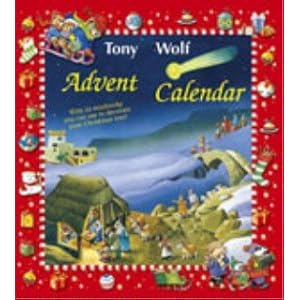
Review – Tony Wolf Advent Calendar – Very Nice

I got one of these “Tony Wolf Advent Calendars” from my local catholic bookstore (not on the website – call and ask if they still have them in stock),  though I see you can find them at any number of major retailers.

What it is: A sturdy tri-fold 24-day reusable Advent calendar.  Opens up kind of like a science fair display, so you can set it on your mantle or sideboard or wherever.  I don’t see a place to hang it on a wall, but it does seal closed with velcro, so you can just put it away after supper and pull it out off the bookshelve the next night (closed dimensions are 14″x13″).

The outside front cover images are of the nativity, and the inside covers are cheerful winter scenes.  For each day of the countdown (December 1-24), there is a tiny board book.  It either contains a bible story, a prayer, or a christmas carol.  Each 1 inch book is designed to be hung on your tree after you read it.  Note this is an authentically catholic Advent calendar, and includes 2 Marian prayers in the set.  (So I’m not sure how that’s going to fly with the spouse.  Maybe we’ll eat out that night.)  The other 22 days are completely protestant-friendly.

The books hit many of the highlights of salvation history, from the creation of the world through the nativity.  Includes David & Goliath, Noah, Jacob & Esau, Moses, all that good stuff.  The carols are “Away in a Manger”, “Oh Come All Ye Faithful” and “We Three Kings”.

Why I like it: First of all, my kids are gonna love it.  The whole thing of 24 miniature books to play school with, all that.   And no candy to fight over.  Then I like the reusable thing, and it folds down compactly, so not much to store from year to year.   (Yes it costs more up front than a cheapo calendar.  But long-term I think you end out ahead.)  As a catechist/christian mom, I like that my kids are getting a refresher of the outline of scripture.  Good stuff.

But the big benefit is An End to the Advent Tree Debate.

First let’s clarify:  There is no way I could ever be organized enough to have a Jesse Tree.  And meanwhile my beloved SuperHusband is desperate, just desperate, to pull the pretend Christmas Tree out the attic as soon as Thanksgiving rolls around.  So now we have a solution.  The tree can come down, and starting December 1 we can add one truly Advent-y decoration to the tree per day.  And then put the Christmas decorations on Christmas Eve.

See?  Marital problems solved by the wonders of modern merchandise.

***

[Technical Notes: Yes, it is printed in China.  The irony does not escape me.  Also has an imprimatur and a nihil obstat (from NY, not China).  Note on the back says “not recommended for use by children under 3 years of age”, with which I would agree, given that at least two of my toddlers liked to eat board books.   The text is more for older children, and the board-book quality is really there so that the things last from year to year.  I strongly recommend hanging these up high on the tree, and making holiday-card ornaments for the lower half of your Advent-tree.]

The Pope as Pastor

A non-catholic internet friend is taking the pope to task for his condom-comments.  (See a good analysis of what was actually said here, or check out almost any one of the catholic blog links in the side bar.)  Her concern: People might get confused.  And then use it launch into 1,001 ‘what if’ scenarios.

Well, she’s sorta right, of course.  But I like that we’ve got such a pastoral pope.  A man who is looking at the whole person, and recognizing even the tiniest glimmer of divine spark, no matter how immersed in a wider morass.

Years ago I was teaching a parenting class series for a local crisis pregnancy center, and the question of smoking and breastfeeding came up.   FYI at the time, the medical consensus was that if you were smoking 20 cigarrettes or less a day, and going outside to smoke — not smoking while you breastfeed — the benefits of breastfeeding outweighed the risk to the baby of having a mother who smoked.   I don’t know whether that opinion has changed over time, but that is what it was at the time, and that is what I told the class.

So immediately, one of the moms says, “But, shouldn’t you quit smoking?  Isn’t it still bad for your baby?”

And my answer was, “Of course you should.”  And I made that clear: If you possibly can, quit smoking.

But what I couldn’t say in so many words, was this: Some of your classmates have come to me privately to discuss how they are working so hard to stay off crack. Out of love for their babies, your classmates are doing their best to dig their way out of a physical, emotional, and social hole so deep and so treacherous, you and I  have nothing, nothing, we have ever experienced that compares to that nightmare.  So maybe she’s not quite in a place where she can just completely quit smoking cigarettes yet?

–> What I see in the holy father’s newly-famous comment is this:  There’s the prodigal son, and he’s starting to look around at the pods the pigs are eating, and wonder if there isn’t a better way.

Is he back in his father’s arms yet?  No.  But his father is standing on that hill looking out already, cheering on every tiny little thing that is one baby step on the path to reconciliation.

The holy father is not speaking about some hypothetical archetype of man.  He’s got the internet in an uproar because he’s peering in at the details of a real life, of a real person living today in our world.  Salvation works itself out in ordinary life.  For a man mired in male prostitution, this might be what that first awakening looks like.

And you know, God is looking at me that same way, I hope.  He wishes my prayer life were here ______, but really it’s only here ____.  He wishes I could move past sins _____, because there are still sins ______ that I don’t even see yet, because I’m still so early on the road.   But am I getting closer? Am I moving in the right direction?  Then that’s something.

We have a patient pope.  He holds out hope even for sinners like me.  I’m good with that.


Writing versus Praying

Am I the only one who has a hard time writing and praying at the same time?  Not at the very same moment.  But in the same day, or the same week.    Seems like my brain does not want to do both.   Prayer life tanks when I decide to be serious about getting some writing done.

Not good.

Willing to take suggestions, or just a stern kick in the pants, if there’s anyone here who has successfully dealt with this.  With the obvious caveat that you are probably a smart, pulled-together person, and I am, well, you know.  As described below.