
Request for Contributions: Effective Communication on Parish Access for You, a Person with a Disability

Hey everyone, I am looking for help, quickly.  My awesome editor of the new book surprised me by wanting more, not less, info on making parishes accessible to persons with disabilities.

The question we need to cover: What is the best way for a parish to communicate with you, and vice-versa, so that your disability (medical condition, etc – so celiac, diabetes, severe allergies, chronic illness . . . all that can have parish-life implications too) can be accommodated right from the start?

Leave your comments at the blog discussion group, or message me on Facebook or Twitter @JenFitz_Reads.

We’re envisioning here both scenarios where the accommodations might already be present but you still have to know about them, and situations where you show up and have to start the process (however simple or complicated) of getting full access to parish life.

I’m looking for firsthand experience from the user-end, not stories of what your parish has provided to accommodate someone else, but what you as the person being accommodated (or the parent, etc., if appropriate) find most helpful in terms of effective communication to make the accommodation happen. Anything at all relevant to that topic.

[Include here also anything related to overcoming human stupidity, when your disability is not something that should be an access issue at all, but weirdly it is because people are dumb sometimes.]

Although I do not know what our total word count for this section will be (and therefore how many detailed stories or quotes I can use), please indicate with your comment whether you are up for being directly quoted or whether you are providing background info only. If you are game for being quoted, let me know what to call you in the book. If you need to be quoted anonymously, PM me (so it doesn’t show up in a public FB feed).  You can refer to yourself by full name, job title, and credentials, or you can give me something descriptive but vague such as “Mary, a retired accountant on the Gulf coast,” or “John, a new convert working with an inner city ministry to street performers,” or whatever suits.

If I already have your story, we’re set, just remind me I’ve got it and give me permission and quoting info if you haven’t done so already. But you might have more to say, or particular details that are pertinent to this specific question. If so, repeat with fresh info or emphasis, please.

***

Related: If you have more stories of excellent examples of being a person with a disability who is involved in evangelizing* (discipling) ministry in some manner in your parish or the community you serve, I’d be interested in hearing two things:

  • The big-picture story of your work (who you serve, how you serve, stories of people growing closer to Jesus), which will just as likely end up *elsewhere* in the book, not related to disability at all.
  • Possibly to be put in the same quote or possibly to be used as info elsewhere, stories on the details of making access happen, whether that be something already built into your ministry or something that had to be organized.

*If you’re doing it right it’s all evangelizing. Don’t get hung up on vocabulary.

What doesn’t make the book will end up getting used somewhere, if you give me permission to do so.  Let me know that.

Thank you!
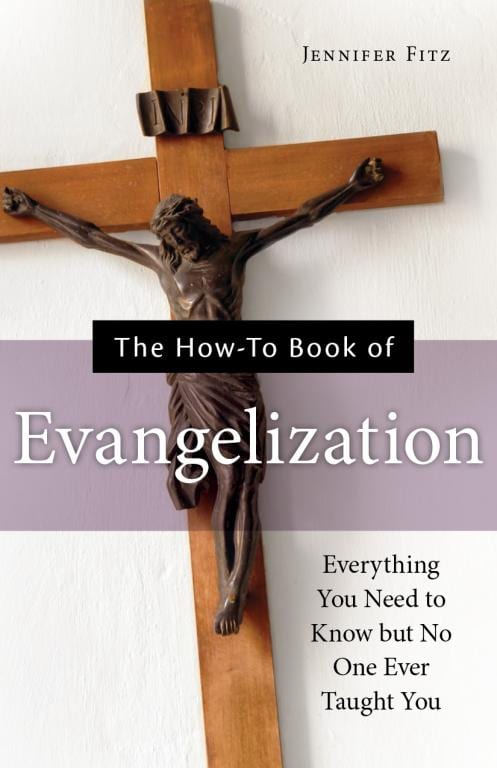
Cover Art/ Image Description: This is the cover of the book I’m asking you to contribute to, The How to Book of Evangelization, coming out in June 2020 from Our Sunday Visitor.  FYI for those who don’t know, publishers come up with book covers all on their own, without the author’s input on the design (they get info from the author all about the book, of course).  So it’s magical that they chose a shade of purple I love, and a big ol’ crucifix splashed across the cover that looks an awful lot the like one I have a view of from my office.  God provides.

7QT: Anatomy of a K5 Bible Lesson

Prologue:  Do you who makes this world a better place?  Editors do.  I finally opened the edits on the manuscript for the new book, and with great pleasure observed that (a) my editor knows exactly what she’s doing and by the end of the month, therefore, a far better book will be headed towards production, and (b) it turns out only one of my chapters needed to be scrapped because it was . . . not what would be helpful to the reader.

This was a good experience, because it means I got to write my mad rant, sit on it for a year, and then come back and write a fresh take that will be pretty awesome, if my notes pulled together during time-outs at a basketball game last night are to be believed.  So that’s fun.

What might I have foamed at the mouth about?  Oh, you know, catechesis.  Shock shock.

#1 It was good that I was writing up notes on catechesis yesterday, because today I was subbing K5 at the kids’ school.  Subbing all-day kindergarten is God’s way of periodically reminding me that fulltime early-elementary teachers possess heroic superpowers.  But a day in kindergarten is the path to making you look forward to working with the 8th and 10th graders again, but also be reminded that five-year-olds are so much fun.  They really are.  Exhausting, yes, but also magically fun.

#2 So we make it through the morning and right after lunch it’s time for a Bible story.  The kids were learning the story of  Esther this week; the other K5 teachers assured me that my chief goal was to reinforce.  I glanced at the teacher’s manual and noted that bravery was the big theme for the day, and that we had Romans 8:28 for a our Bible verse to fit with the theme.

#3 When you have to call a sub at eight at night, you aren’t necessarily able to get everything laid out the way you’d hoped.  My colleagues clued me in to hunt the room for the Bible story card that goes with Esther, and I found it hanging on the wall.  When I pulled it down, there were four other stories behind — two from David, plus the Nativity.  These were super props: Large format, laminated, full-color illustrations of the key moment in a Bible story; on the back side the story is printed ready-to-go.  Good thing, if you’re the sub who needs to be prompted on what story you’re teaching, heh.

And here’s thing about teaching religious ed: You are almost always going to have to assess the mood of the room, see what resources you have, and make quick decisions.

We had these big pictures.  We’ll be using the big pictures.

#4 So we started with the first picture, and I asked who remembered what story this one was.  I called on a raised hand to narrate (I’m sorry I can’t call on you unless you are sitting quietly), got a decent retelling of key points, and called on a second student to add any missing details.  I gave it a one-sentence summary (we’re just reviewing here), and per the lesson plan emphasized the theme of bravery.

Quick move to the second card, repeat with two different volunteers.  Third card showed Mary, Joseph, and baby Jesus in the manger.  First volunteer talked about them traveling to Bethlehem and asking for a room at the inn.  Second volunteer talked about the flight to Egypt, because king Saul wanted to kill baby Jesus.

Oops.  No dear, Saul was the one hunting David, previous story.  This time it’s Herod.  No big, and then emphasize again, in teacher-recap, the bravery of Mary and Joseph.

All that was review, and it let the talkers get some talking done and got everyone thinking about those pictures and therefore churning through whatever they could remember of Bible stuff they’d learned in the past.

Then onto the fun bit.

#5 You can’t keep talking and talking.  These are five-year-olds.  Time for some action.

Our key idea is bravery.  The kids were able to remember something about the bad guy in the picture wanting to kill Esther, and that she was the queen.  I reviewed (two or three sentences, max) the key facts of the story, and then had a volunteer come up to the front and sit on a chair and be a king on his throne.

Something that makes Esther brave is that she approached the king without permission, which was a capital offense.  I explained that if the king calls on you, you can come to talk to him.  I let the king call on three volunteers and give them permission to speak to the king.  Each in turn approached the throne, said, “Hi King,” and then went back to their seats.  Perfectly safe.

Good.  Now someone needs to die.  That requires expertise.  I explained to the class that now I was going to approach the king without asking, which means he can have me put to death.  I walked up to the king, and prompted him to tell me, “Off with your head!”

He did.  I promptly dropped dead dramatically, with much more noise and rolling on the floor than decapitation might usually involve.

Kindergartners love it when you do that.

So you calm the class back down, tell them no one else gets to die right now, except maybe . . . Esther.

Pick another volunteer to be the queen.  Explain that your husband the king doesn’t know you need to talk to him, and you have to, because the bad guys want to kill your people.  But of course he could order your head chopped off — we all saw it happen just a minute ago.

So Esther approaches the king, I give the prompt for her line, “Can you please save my people from the bad guys?”

And then as the director here I ask the kid playing the king, “Did the king say, ‘Off with your head’ or did he say ‘Yes, I will save them.’?”

He got the line right and gave a nice clear answer to his stage-wife, “Yes, I will save them.”

#6  I wrap up with a tie back to the Nativity, and how the people saved by Esther’s bravery were the nation God chose to be the family of Jesus, our Savior.   David, Esther, and many other people were called by God to be brave, and all of them saying yes to God led up to the day when Jesus was born.

Now time to wrap up with a closing prayer.  My intuition was that it was time to go Ignatian.  This is K5, so you don’t have a lot of time.  I had the kids close eyes to pray, and then in my prayer thanked God for the bravery of His saints, the gift of salvation (“coming to be our Savior and opening up Heaven so we can be with you forever”), and His promise to be with us and give us strength and courage when things are scary.

Then, still praying, and making sure all the eyes were closed, I told them to imagine something scary that happens in their life, and then imagine Jesus being there with them, providing help and encouragement and the ability to be brave.  Now quietly imagine telling Jesus, who is there with you, thank you for being with you. Amen.

#7 That dropping dead thing?  Big kids like it too.

File:Book of Esther Chapter 7-4 (Bible Illustrations by Sweet Media).jpg

Artwork: Illustration from the book of Esther, courtesy of Wikimedia Commons, CC 3.0.

Q&A: What Does it Take for a Rosary to “Count”?

On another forum the question was raised, and if it’s being asked there then it is probably of interest elsewhere: What does it take for a rosary to “count”?  If you want to be able to honestly claim you prayed the rosary, what is the minimum that must be done?

My answer . . .

There are some very limited situations where it matters whether your rosary “counts”:

  1. If it is the penance assigned to you in Confession. If so, follow the instructions in a booklet or similar resource on how to pray the rosary; presumably the priest who assigned the penance has such a thing on hand or else confirmed in advance you knew how to pray the penance.
  2. You are committed to praying the rosary daily because of your affiliation with a religious order or apostolate, such as being an auxiliary member of the Legion of Mary. If so, follow the instructions set forth by the organization to which you belong.
  3. You’ve pledged to say a rosary on someone’s behalf, and you were quite specific it would be a rosary, not just prayers in general. If so, go with booklet instructions as above.

Otherwise: Doesn’t matter. It’s you and God spending time together loving one another. Think of it as going on a date . . . you wouldn’t spend your time wondering whether the date “counted”.  I hope?

UPDATED

Over in the discussion group, a reader kindly reminds us that if you wish to receive a plenary indulgence for praying the rosary, there are instructions on that.  Which you’ll want to keep straight.

Two nice links to go with the update:

Enjoy.