Why I Love My Parish Catholic School

This time a year ago, my littlest homeschooler asked if she could go to St. Urban’s, the elementary school that serves several parishes in the region. We knew some of the families at the school and liked what we saw.  She had made friends with girls her age at parish events.  It was not an agonizing decision, because we had already been considering the move for about a year.  We did a little more research and decided this was the time.

Our experience so far has been nothing but positive.  Since this is Catholic Schools Week, let me share a few of the reasons we love our school.

Everyone is kind and friendly.

When I was researching the school, I spoke to a friend who had volunteered there and at a number of other elementary schools in the region.  She said to me: “I can honestly say that St. Urban’s is what a Christian school should be.”

The administration actively works to promote kindness and encouragement among the students.  Recently on the drive into town my daughter told me she had to write a persuasive paper, and she had chosen the topic of whether there ought to be school uniforms. She asked my opinion, and I gave her the long list of reasons mothers love uniforms (thank you, school, for a simple, stain-resistant, affordable set of uniform options).  I finished up by adding, “And that way, for example, a mean girl can’t say oh your skirt is so ugly, because she’s wearing the same skirt.”

To which my daughter replied: “Mom.  This is St. Urban’s.  We don’t have bullies.  The worst thing that happened is that Scholastica wanted to play with Benedicta at recess but not Ignatia, and then they all ended up playing together anyway.”

The friendliness is welcoming to me, too.  The administration respects my time.  The school’s academic reputation isn’t built on sending home young children with mountains of homework every night. We parents aren’t saddled with a bazillion overwhelming volunteer projects and fundraisers.  When teachers or staff do ask for parent help, they take into account our varying circumstances.

I know some private schools have a “type” of parent, and if you don’t fit in you’re on the outs.  Our school is truly Catholic — truly diverse.  Not just in terms of race and national origin (though there is that), but also in terms of the parents’ professions, state in life, personalities, and dare I say it: social class.  It’s not a prep school, it’s a parish school.

Our faith as Catholics is 100% supported.

The school Mass is both beautiful and edifying.  Prayer is part of the rhythm of the day.  There are Bible verses on the walls, a well-delivered religion curriculum, and an enthusiastic attitude towards Catholicism that permeates everything the school does.  I don’t know all the teachers very well, but I know that the two teachers who have the most influence on my daughter both exhibit a sincere and profound faith.

Before she went to school, my daughter was homeschooled by me.  There are ways the Catholic faith was shared in our homeschool that don’t happen at the parish school, but the reverse is also true.  When I came to eat lunch with my daughter, I asked her as we sat down and pulled out lunch bags, “Do we wait for grace?”

“We already said grace in our classroom,” she said.  “And also the Angelus.”

The children ate and then talked quietly.  The teacher who was serving as lunch monitor complimented the children, as a group, on how her husband had been moved to tears by their beautiful singing that Sunday at Mass.  The children swept up and prepared to leave.  Before dismissal to recess, everyone stood and faced the massive crucifix in the cafeteria and prayed the second grace, thanksgiving after the meal.

My daughter’s teachers know her.

The school is small.  There are about fifteen children in each grade (it varies), so that the total school enrollment hovers comfortably within knowable limits.  (See here for the theory of Dunbar’s Number, and here for The New Yorker’s explanation of it.  I have found this to be true in practice.)  My daughter has been with the school less than six months, and already knows the names of all the students except the very youngest.  But more important me: Her teachers have time to know her.

When I went to the parent-teacher conference after the first quarter, the 5th grade teacher sat down with me and talked about my daughter. She talked about my daughter’s strengths and weaknesses; what she needed to work on; and how her transition to school was going.  To all of it, my only answer was: Yes, you are correct.

I’ve been teaching and rearing this child for ten years, I know her.  All these things you describe? That’s my girl.  You’ve paid attention, you’ve gotten to see the real her, you obviously care about her.  She’s not lost here.  There’s a real relationship going on, rooted in both love and quantity-time spent together getting to know one another.

The curriculum is well-chosen.

Between homeschooling and my years of small-format teaching in religious education, chastity education, parenting classes, French, economics, logic, debate, apologetics, can’t remember what else, and maybe a little tutoring here and there . . . I’ve evaluated curriculum.  Oh and I wrote a book that has a thing or two to say about how to structure a class.

If nothing else, I know how to see whether a class is working or not, and what is or isn’t successful.

Everything that happens at our parish school makes sense.

Sometimes the book the teacher is using is right off my shelves, sometimes it’s one I’ve never heard of before.  But I am still waiting for the day when I see some assignment or activity and can’t figure out what the point is. Everything I’ve seen so far fits with the goal.  I can immediately see why the teacher chose a particular activity, and how it fits into the bigger picture.  There is no busy-work. Everything converges on a well-built whole.

Sure, I’d heard it was a decent school, but I wasn’t quite expecting it to be this good.  I’ll take it.

The school makes the most of its strengths.

One of the mistakes people make about homeschooling is thinking that it’s supposed to be just like school.  That approach doesn’t work.  Homeschooling isn’t for that.  Homeschooling has a dynamic that’s unlike school, and that’s part of the point.  If you try to re-create school at home, you’ll be harried and overwhelmed.  The trick to homeschooling is to make the most of the distinctive strengths that only homeschooling can offer.

My parish school does that too.

There are ways to teach and learn that can only happen when you’ve got a dozen or so students the same age.  There are cooperative projects with other programs nearby that take advantage of St. Urban’s downtown location.  Even the way the classes are organized teacher-by-teacher makes sense developmentally — at least in the upper grades, which is what I’ve seen, the right teacher is assigned to each grade and specialty subject.

My daughter loves it there.

No school can be everything to everybody.  My daughter thrives on structure, gentle but firm discipline, clearly stated learning objectives, and frequent feedback via formal assessments.  Any time a child changes school systems there’s an adjustment period.  She didn’t arrive at school having mastered The Way Things Are Done Here.  Her teachers brought her up to speed through a steady combination of clear correction and enthusiastic encouragement.

She’s a normal kid.  Left to her own devices, she’d gladly sit around watching sitcoms and eating endless bowls of ice cream.  There’s a time and place for leisurely pleasures, but what she gets at St. Urban’s — the reason she’s excited to go to school every day — is the profound happiness that comes from having her genuine needs met so well.  Her need for love, her need for guidance, her need for growth: Everyone at the school works together to do their part in meeting those needs.

Addendum: About that award she got.

Some people from the parish who read this blog might be thinking You’re just all rosy in the afterglow of your kid getting an award after Mass this morning.  Truth?  It’s the other way around.  I started writing this post in my head months ago, and sat on it because I kept waiting for the inevitable bad day to show up so I wouldn’t be all honeymoon-googly-eyes.  I started writing this post on my PC earlier this week, but it’s been coming along slowly because my primary vocation keeps getting in the way.

And thus before I could finish writing, first semester Awards Day came around.  You know what happened?  They quick gave out certificates to the honor roll kids, and then moved on to the big event.

What’s the big event?  Grade by grade, each teacher gave a short talk about two students in her class who merited particular distinction.  One student was lauded for attitude, effort, and improvement academically — not for grades earned, but for the student’s perseverance and diligence regardless of academic difficulties.  The other honored student was praised, in descriptive detail, for kindness, integrity, piety, generosity — all the virtues that aren’t about being Number One, and are about being more like Jesus Christ.

That’s what I want in a Catholic school.

File:Pages from a hundred years of Dominican history - the story of the Congregation of Saint Catherine of Sienna - by Anna C. Minogue (1921) (14587455058).jpg
The sisters agree: If you cultivate the virtues, you’ll get the best academics you can have.


A page from 100 Years of Dominican History, published in 1921.  Photo by Anna Catherine Minogue, b. 1874 [No restrictions], via Wikimedia Commons.

The Solution to the Big Parish Problem

Yesterday I wrote about why ever-expanding parishes are a sign of trouble. This does not mean that a big parish is a bad parish; it means that if a diocese is growing in pewsitters but not in religious vocations, it’s growing spiritual fat, not muscle.  The good news is that stored energy, in the form of pewsitters, can be converted into a healthy Body of Christ just as soon as the head makes up its mind to start doing the things it takes to regain spiritual vigor.

A large parish that is pulling this off right now is St. William’s in Round Rock, Texas.  Over at the blog discussion group, Martina Kreitzer writes:

You should come visit St. William in Round Rock, Texas. We are the largest parish in the diocese with no sign of growing slower. Our post confirmation program retention rate is 4x the national average . . . and our parish faith formation programs (pre-k through high school) are thriving in ways that make our “mega church” work. We are also blessed to be a 100 year old parish in which the founding family still attends (and can often be seen in the trenches of service oriented work). We come from humble beginnings, have a multicultural background, and are rich in heritage – Mexican/Anglo/rich/poor, etc.

You should come talk to our priest, Father Dean Wilhelm, our adult faith formation director Noe Rocha and our high school and middle school youth ministers, Chris Bartlett and Gwen Bartlett (they are brother and sister). They are also co-founders of a mentoring ministry called Next Level Ministry, designed to help youth ministers get the most out of their programs.

Martina is behind the Jesus is Lord program, one of the key elements of St. William’s success, and which you can read about in detail:

Jesus is Lord Series Introduction

Week 1: God’s Love

Week 2: Sin and It’s Consequences

Week 3: Salvation – God’s Solution for Sin

Week 4: Repentance – Recognize and Receive

Confession

Week 5: Holy Spirit – Going from the Seat to the Feet

Prayer Session

Week 6: Jesus is Lord of My Talent

Week 7: Jesus is Lord of My Time

Week 8: Jesus is Lord of My Treasure

Week 9: Jesus is Lord of My Sexuality

Week 10: Intentional Discipleship and Commissioning

Is this program suitable for parishes not quite like St. William’s? Definitely.  It’s being used at Texas A&M’s legendary St. Mary’s Catholic Center, where vocations are flourishing.  You can watch the campus video series here.

What is this “Intentional Discipleship” business?

Back up a second though and notice the title for Week 10 of the Jesus is Lord series.  If you are not familiar with the concept of “Intentional Discipleship” you need to read Sherry Weddell’s excellent books on the topic, Forming Intentional Disciples and Becoming a Parish of Intentional Disciples.  The first book explains the problem, and the second tells you step-by-step how to solve it.  Book three, Fruitful Discipleship comes out in April 2017.

FID and BPID are both best suited to intermediate-level lay readers. You don’t have to be a genius or on staff at the parish, and both books are eminently readable, but when my own discipleship group read FID, some of the members found the density of the book a little overwhelming.  After you’ve read the book yourself, if you want to communicate and discuss the ideas in Forming Intentional Disciples with a broader audience of parish lay-leaders and future lay-leaders, the free CatholicMom.com study guide for Forming Intentional Disciples provides a snapshot summary of the key ideas and a few discussion questions for each chapter.

For the whole dang parish, Brandon Vogt’s book Return: How to Draw Your Child Back to the Church is an excellent 101 on evangelization and discipleship for the ordinary Catholic.  He offers a video course as well, which I haven’t reviewed but which you may find helpful.

So there you go.  And if all fails, The Catechism of the Catholic has a few pointers as well.


Why Big Parishes are a Bad Sign

In the past few weeks I’ve gotten to visit two of the Diocese of Charleston’s newest parish church buildings.   St. Paul the Apostle in Spartanburg and St. Mary Help of Christians in Aiken are both well worth a look.  (Our Lady of the Rosary is still on my sightseeing wish-list; meanwhile, for something fun, go see the stained glass at St. Andrew’s in Myrtle Beach — there is more information about those windows available at the church when you visit.  If you’re off the beaten path, Our Lady of Lourdes in Greenwood is charming and bright — the photos don’t do it justice.)

We are fortunate to live in a diocese where good design is flourishing.  I don’t for a moment wish to naysay any of the hard work and sacrifice that went into creating these beautiful new buildings.   On the contrary — I am grateful beyond expressing.

But let’s not delude ourselves: The very existence of some (not all) of this new construction should be an elegant, delightful, but shocking warning sign.

The Myth of the Flourishing Parish

Let’s look at St. Mary’s as a case study.  The original St. Clare’s chapel, now devoted to perpetual Eucharistic Adoration, was succeeded by the first St. Mary’s Help of Christians parish church early last century.  You can read an insightful history of Catholicism in the region — dating back to the 16th century — here.  The historic St. Mary’s parish church is still in use.  It wasn’t replaced because it was no longer habitable.  It was replaced because there were too many parishioners to fit into the building.

This sounds like a good problem, right?  It is, in a way.

It would be more accurate, however, to say: There were too many parishioners for the number of priests.

The Catholic population in Aiken, SC, as with the rest of the diocese, has grown significantly due to retirees moving south (we get your empty church parts to refurbish our buildings), professionals moving here from other parts of the United States, immigrants arriving from around the world, a certain number of conversions, and of course old-fashioned human reproduction.  Some of this represents spiritual growth; some of it is just other parts of the world sending us their Catholics.

But regardless of the cause, an unavoidable fact is now set in stone, brick, and concrete: We are not producing priestly vocations in adequate numbers.

A Faith Not Even Worth Living For

The Diocese of Charleston has a good vocations program going.  There’s always room for taking any initiative to the next level, but over the past twenty years the diocese has gotten conmendably serious and hard-working about reaching out to would-be seminarians.  We do have vocations flowing.  We have some superb new priests, and more on the way.  Fr. Jeffrey Kirby didn’t receive the state’s highest civilian honor for nothing.

Still, the arithmetic doesn’t lie.  Some parishes are on fire with the faith.  Some Catholics — in every parish — are wildly in love with Jesus and have the fruit to prove it.  But mostly we have to make larger buildings because we have pewsitters who love the pews, but who wouldn’t want to get carried away with any craziness.  Catholicism is legit here these days.  Church-going is civilized.  If you’re nicely married, it’s a wholesome place to raise the kids.

We feel good about our faith and we do good works, but it’s not the kind of thing you’d really give your life over for.  We pat ourselves on the back if we get the teens to Adoration for ten minutes.  We’re wildly excited if a young couple gets married in the Church — the idea that most young adults would remain Catholic after high school is a rich fantasy.  Some statistics, via Brandon Vogt:

  • 79% of former Catholics leave the Church before age 23 (Pew)
  • 50% of Millennials raised Catholic no longer identify as Catholic today (i.e., half of the babies you’ve seen baptized in the last 30 years, half of the kids you’ve seen confirmed, half of the Catholic young people you’ve seen get married)
  • Only 7% of Millennials raised Catholic still actively practice their faith today (weekly Mass, pray a few times each week, say their faith is “extremely” or “very” important)
  • 90% of American “nones” who left religion did so before age 29 (PRRI)
  • 62% leave before 18
  • 28% leave from 18-29

If you’re not even Catholic, you are highly unlikely to become a Catholic priest.

Old Warning Signs

For as long as I’ve been talking to catechists and faith formation leaders, the refrain has been the same: “The kids in religious ed don’t even go to Mass.”  Some do, of course (mine, and quite a few others I know), but a surprising number of children are dropped off for CCD but never taken to Mass.  The situation is so dire that some parishes have resorted to requiring children preparing for sacraments to provide hard evidence they attend Sunday Mass, such as getting a bulletin signed.

Here’s another example by way of a personal story. My daughter’s would-be confirmation sponsor is an ardent young Catholic well known by many in the local Catholic community. As we put together paperwork, however, we discovered that due to an oversight when the family purchased a new home, they are not presently registered at the parish they attend most.  We’ll get it all straightened out one way or another, don’t be scandalized because there is no scandal.

But the underlying situation is this: It is now the rule that the way we “prove” someone is a “practicing Catholic” is via a set of papers and financial transactions.  Get registered, turn in collection envelopes, and you qualify for a “Catholic in Good Standing” letter.  The idea that one could simply be a faithful Catholic known in one’s community is utterly foreign to the present practice.

What if you trusted people when they said the godparents or sponsor were good Catholics?  We have come to fully expect people would outright lie as a matter of course.

Thus we live with a different set of lies.  We as a Church are so alienated from any sense of real community that we depend on bureaucratic proxies that supposedly indicate a practice of the faith, but everyone knows that they don’t.  Everyone knows that teenagers go through confirmation to make their parents happy, and then drop out at first opportunity.  Everyone knows that the confirmation class is composed of kids who last attended Mass at their First Communion.  Everyone knows that when we teach the Catholic faith assiduously, the kids whisper to themselves, right there in class, which parts they think are bunk.

The parts they think are bunk are almost invariably the parts their parents likewise think are bunk.  The Catholic Church is the stronghold of people who know how to shut up, smile, and get along.

Repeating Ourselves to Death

Any student of Church history can attest that things have always been shockingly bad.  The behavior of Catholics is the incontroveritble evidence that God must be holding this institution together, because it sure isn’t us.  That is not, however, an excuse to keep on behaving badly.

I write this today because I’m concerned that our beautiful new buildings will lull us into continued complacency.  We will persuade ourselves that what we’ve been doing is working.

It isn’t.

The buildings themselves cry it out.  We shouldn’t have mega-parishes.  We should have enough priests that when the parish overflows, we’re ready to form a second parish nearby.

The lack of priests isn’t some mystical aberration.  God isn’t suddenly pleased with the idea of men exhausted from administering multiple parishes and saying half a dozen masses in a weekend and having to rely on collection envelopes to know who comes to Mass because they couldn’t possibly meet all the parishioners they are supposed to be pastoring.  Nonsense.

We have no priests because we are very good at getting along and forming lovely clubs, but we are terrible at being Catholic.

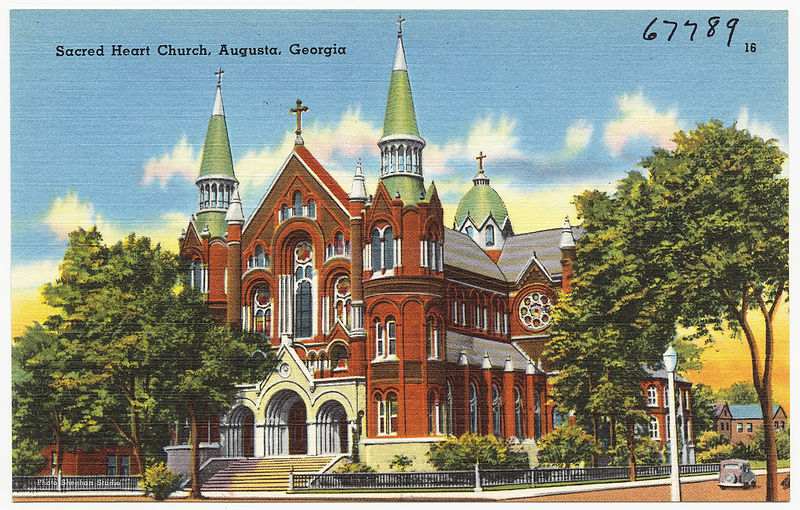
If we don’t change this, St. Mary’s beautiful new building in Aiken will enjoy a brief sojourn as a Catholic Church, and then go the way of Sacred Heart across the river, no longer a church, now just a lovely but Godforsaken building.

File:Sacred Heart Church, Augusta, Georgia (8342846689).jpg

Artwork: Postcard courtesy of Boston Public Library (Sacred Heart Church, Augusta, Georgia) [CC BY 2.0, Public domain], via Wikimedia Commons


PSA: Short Workouts for the Win

If you made ambitious fitness resolutions this year, they have probably fallen apart by now.  If so, this message is for you:

Try small workouts instead.

By “small” or “short” what I mean is an amount of exercise that seems hopelessly ineffective, but that you can actually manage to do.

When I was racing, “short” was a thirty-minute sprint on the bike.  When I was so sick I couldn’t walk an 1/8th of a mile, “short” was ten sit-ups, then lay on the floor and recover for five minutes, then do ten more.  Your “short” is someone else’s “long,” and your “big” is someone else’s “small.”  The key here is that if you are not succeeding at what you think you should be accomplishing, try scaling back instead of giving up.

Are short workouts beneficial?

Yes!  At the extreme end of the spectrum, here’s a study that found that breaking up a long day by just 1 minute and 40 seconds of exercise every hour results in lower plasma glucose and insulin than sitting around with no exercise break.  Even if you are ill to the point that you can do almost nothing, you’re still better off getting micro-bouts of exercise than doing nothing at all.  (And in fact, you’re better off than if you workout for thirty minutes then sit all day, the study found.)

If you can exercise more, have at it. But if you can’t seem to pull that off, trying doing something instead of doing nothing.

10 Reasons Short Workouts Succeed

The main reason I recommend short walks or other exercise is that it works.  That other thing you aren’t doing isn’t working.  This is a thing you can do.

#1 You can slip a short workout into a tight schedule.  The boss probably won’t let you spend 30 minutes mid-morning at the gym, but might be fine with five minutes walking around the building while other people are lounging at the coffee machine.  The spouse might not be ready to watch the kids for an hour at the end of a long day while you go off to do a super-workout, but probably can manage fifteen minutes while you sneak out and run sprints.  The baby will be hungry and angry after forty-five minutes in the stroller, but might put up with ten minutes.  You might have children at the in-between age when they can’t be left alone for long periods, but can safely occupy themselves while you jog around the block.

#2 Short workouts are easier on the wardrobe.  Not every workout can be completed in any clothing at all, but you can do push-ups while wearing business-casual, or go out for a quick walk in clothes you wouldn’t wear for a 5k.

#3 Short workouts are more weather-resistant. If it’s extremely hot, cold, windy, or wet, your body can tolerate short exposure with much less preparation and stress than long exposure.  If it’s snowy, a short trudge through the snow is realistic, a long hike through the snow is exhausting.

#4 Short workouts are easier to orchestrate and harder to miss.  You don’t need a lot of space or a gym to do some quick calisthenics.  You might not have time to go out for a three-hour bike ride, but you can ride your bike to the store for groceries.  You might not have immediate access to a good place to go for a forty-minute walk, whereas if you’re just getting out for five or ten minutes, you could do laps around the block, down to the corner store and back, around the parking lot, around the building — lots of options.  Likewise, if you get to the end of the day and still haven’t exercised like you hoped, you probably can’t cause an extra hour to be added to your day, but you could squeeze in a ten minute walk or a stack of push-ups and sit-ups.

#5 You can always go longer.  If you think the toddler’s going to mutiny after ten minutes but she’s still happy as a clam, you can keep on strolling.  If you thought you’d be exhausted after just your short circuit because you’re a weakling that way, but actually you feel great, you can add on more time.

#6 You can test the waters. Sometimes you feel sluggish because you’re getting sick and need to rest, and other times you feel sluggish because you need to get up and move around and clear your head.  If you go out for a short walk and it makes you feel better, you can keep on going or else make a note to do a more vigorous workout later in the day.  If you go out for what would normally be a refreshing short walk and instead you feel like you’re made of lead, you know you really should take a rest day.

#7 Short workouts keep you fit for bigger, better days.  If you have a sport you like to practice on weekends or vacations or with the team once a week, fitting in small workouts during your “off” days maintains a level of fitness for your sport that can help prevent injuries and improve your performance.  If you are currently dealing with a health or personal situation that prevents you from exercising the way you’d like to, small workouts now provide a base for safely ramping up to bigger things when the time finally comes.  If your life is always erratic, working out in small ways when opportunities are scarce allows you to take the most advantage of the odd spurt when you can do more.

#8 Short workouts work well with injuries.  You might not be able to put miles and miles on your bad knee, but maybe you could still do a lap or two — some walking is better for bone density and posture and heart health than no walking.  You might not be sure how to exercise for an hour without aggravating your back, your shoulder, and your spider bite, but you might be able to think up ten minutes worth of exercises that don’t make anything worse.

#9 Short workouts every day mean fewer days with no exercise.  Let’s say you pencil in two big workouts a week.  If you blow those days, they’re gone.  You might not have two other days when you can set aside that much time.  If your plan, in contrast, is several short workouts each day, if you don’t make your full goal for the day, you might still make half your goal.  If yesterday was a bust because you had that horrid cold that’s going around and also you were trapped in the cellar waiting out a tornado, today you can still get something done because you aren’t scheduling all-or-nothing exercise days.

#10 Short workouts don’t sabotage bigger workouts.  If your normal routine includes long, intense physical exercise, you aren’t going to blow yourself out by taking a quick walk around the block.  If you ride your bike three miles to work because you think you’re going to have to stay late and not be able to go on a real ride, and then the client reschedules and thus you can get your big ride in, those three miles aren’t going to prevent you from riding the other forty.  50 sit-ups this morning aren’t going to prevent you from finishing your whole CrossFit routine this evening, if it turns out you can get to the gym after all.

If you’re getting a lot of exercise, keep on doing that.  But if you are getting zero exercise, try aiming for an amount you can definitely accomplish.  You can always add more.

File:Promenade plantée, Paris August 2009 (20).jpg

Photo by Jean-Louis Zimmermann from Moulins, FRANCE (coulée verte (PARIS, FR75)) [CC BY 2.0], via Wikimedia Commons

How to Get Your Young Athlete to Sunday Mass

I’m not a fan of sports on Sundays.  I’d like to stay home, go to Mass at my local parish, then spend the day relaxing with friends.  Instead, I’ll be at a tournament this weekend, watching one of my top favorite athletes in the world do her thing.  Also, she and I will be going to Mass.  If you’ve ever had a child involved in competitive sports, you know that’s not as easy as it sounds.

Should You Even Be Playing on Sundays?

There are two questions every Catholic parent of an athlete ought to ask:

  1. Should we, as Catholics, even be participating in Sunday sports?
  2. Should my child in particular be involved in such sports?

The first question has been answered, for the moment, by silence and logic: I’ve never heard any priest or bishop forbid the faithful to watch the Olympics, professional football, or any other sport.  These activities take place on Sundays, and furthermore they require a decade or decades of training that involves, almost invariably, playing or practicing on Sundays.  If it’s moral to participate as a spectator, it’s moral to participate as an athlete — you can’t have one without the other.

That said, if at some point the Church should study the matter and determine that it is in fact immoral to play sports on Sundays, there we’ll be.  (I don’t mean kickball at home with your friends.  I mean the kind that dramatically interrupts church and rest for all involved.)  Until then, we have a conditional green light to play on.

So long as Question #1 remains a tentative yes, Question #2 is up to you as the parent to discern: There are many good reasons not to play sports on Sundays.  Some of those reasons may well apply to you.  Discern thoughtfully.

Plan Ahead. Way Ahead.

Let’s imagine that for some good reason you’ve determined that your child ought to participate in a sport that plays or practices on Sundays.  I hope if you had another option (a team with Saturday games only, for example) you took it.  But say this was your only realistic choice:  How do you make sure you’ll still get to Mass?

Answer: Talk to the coach before you sign up with the team.

Sooner or later, you are going to find yourself in a corner.  You’ll be playing in some town that only has Mass the same hour your child is scheduled to compete.  Your coach needs to know before you join the team that if push comes to shove, your player will be at Mass.

At that point, the coach might let you know that you should look for another team.  So be it.  It’s one thing to stretch the very limits of our freedom as Catholics; it’s another to abandon the faith altogether.  But chances are your coach will be willing to accommodate you, if you hold up your end of a fair deal.  What does that look like?

Don’t Be Obnoxious

You don’t have to make a big scene to the other families on the team about what amazingly holy people you are.  Come on: You’re playing sports on a Sunday, not fasting in the Adoration chapel.  You aren’t that holy.  Put together a list of parishes within striking distance and all their Mass times.  Then, when you get a break in the schedule, quietly head down the road to church.

Go to the first-available Mass opportunity you get.  You don’t want to miss your one chance to get to Mass free and clear, only to have to hurt the team later by skipping out on a game.

If you have more than one child playing at the same event but with different play times, ask around and find out if there are any other Catholic families also trying to get to Mass.  If your children’s breaks should line up just wrong, sending one child with another (trusted) family may be the only way you can get all children to Mass.

If you know you’ll have to skip a game, talk to the coach.  Have your list of Mass times laid out in a way that’s easy to understand, and let your coach pick which game your child should miss.

Be willing to accept any consequences that go with missing a game.  Charitably assume your coach has good reasons for having to bench your child if you miss a game.  If you don’t trust your coach’s decisions, look for a different team.

Be Ready to Do the Unreasonable

When you make your list of potential Mass times and locations, include every possible option, even if some of them are just horrible.  So you have to spend three hours on dirt roads getting to and from the Ancient Slobovian 10 pm Mass on your way home after a long weekend? If it’s a safe possibility, the fact that you’ll be inconvenienced is beside the point.  If you want convenience, competitive athletics is not for you.

There can be times when there is no safe way to get to Mass.  Weird things happen. In the winter you might, for example, be playing at a venue that is on well-maintained roads just off the interstate, but the nearest Catholic parishes are deep in the hinterlands with long stretches of dangerous ice patches.  Likewise, don’t be on the road later than you can safely stay awake to drive.  It’s better to skip a game and go to Mass during the day than to risk your life taking one for the team.  

But if there is a way to get to Mass without missing any games, take that option even if isn’t your favorite choice.  Don’t put the team dinner, touring around, or a relaxing morning at the hotel ahead of your obligation to attend a Sunday Mass.  Save your miss-a-game cards for when you really need them.

The How-To’s of Finding a Mass

  1. Look up your event location, then search Masstimes.org for nearby parishes.  If your hotel is in a different area, look for parishes near your hotel as well.
  2. If you will be traveling home on Sunday, look up parishes along your route home in addition to those near the event.
  3. Click through to the parish websites, and confirm that the Mass schedule is up to date.  Watch out for holiday schedules in particular, as Mass times can get irregular.
  4. Make yourself a list of parishes and their Mass schedules.
  5. Either include each church’s address in your list so you can get directions on the fly, or print out directions from the venue or your hotel (or both — whichever you are most likely to be leaving in order to attend Mass).

If you know the tournament schedule in advance, you might be able to pick out which Mass you’ll be attending ahead of time.  Otherwise, watch for an opening as the weekend unfolds.  When you get a chance head to Mass, out you go!


File:Karol Wojtyla-splyw.jpg
Photo courtesy of Wikimedia [Public Domain]. Some guy who liked sports. Click through for details.
Related Links:

Come to Mass Ugly, Please

Is the Mass Just Like Everywhere Else?

Three Ingredients for Parental Sanity in Kids’ Competitive Sports

Sabbath 101: Giving Up the Work Habit (I know! I wrote that!  And I still believe it, even if my life interferes.)

What Happens When You Go Out to Eat on Sundays (So do what you can to minimize your impact, however imperfectly you pull it off.)


Copyright Jennifer Fitz 2017.  If you would like to reprint this article for your parish or diocesan publication, you may.  Please credit the original link.

How to Make the Best March for Life Signs Ever

If you’re going to the March for Life, local or national, you are going to end up with a sign.  If you don’t bring one, helpful people will give you one, and then you’ll have to carry it.  Or you could go ahead and make the best sign ever: It’s lightweight, compact, easy to carry, and will keep you warm if the weather behaves like January tends to behave.

Bonus: It isn’t any more difficult to make than a regular posterboard sign.

Fleece March for Life Banner Instructions

What you’ll need:

Approximately one yard of fleece fabric.  If you have an old blanket you want to re-purpose, that works too.  Err on the side of choosing a solid color unless you’re really good at visual design.

Fabric paint and stencils, or some other way to write your slogan on your banner.  Go with something that will contrast with your fabric.

A length of rope a foot or two longer than the width of your fabric.  A walking stick would work, too.

Needle & thread, a sewing machine, or a bunch of safety pins.


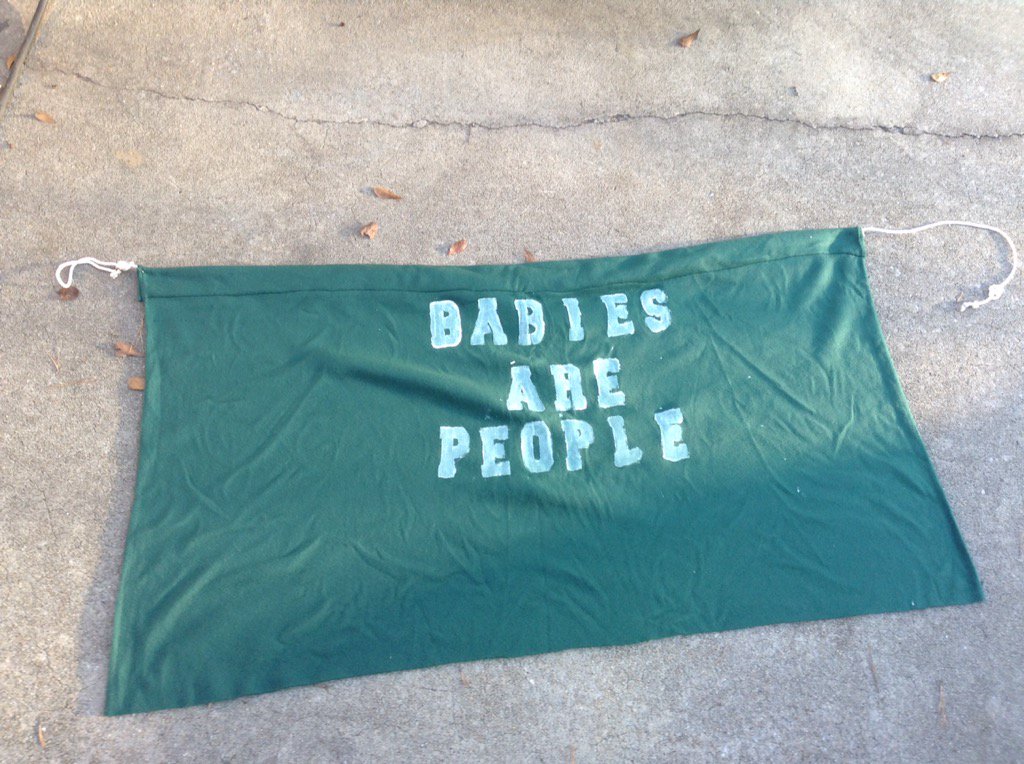
Step 1: Think up your slogan.  Since your banner will roll up into a teeny tiny slot in your scarf stash, you’ll use it again in future years. So pick something simple and enduring.  Yes: “Don’t Kill Innocent People.”  No: “Please Pass Prop 37 on July 16th, 2012.”  My then-six-year-old came up with Abortion is Bad for our local March, but half a decade later the girls chose the much more subtle Babies are People when we went to the big March in DC.  I Regret My Abortion and Suicide is Never the Answer are good ones too.

Step 2: Hem or pin your fabric.  Lay out your rectangle of fleece, then fold over the top edge of the future sign.  Stitch or pin the folded-over edge so that you have a slot for your length of rope or stick.  Tip: If you’re using rope, it’s a pain to work it through the slot after you’ve stitched.  Go ahead and lay it in place before you sew.

Step 3: Add your slogan.  If it’s easier (depending on how you are attaching your letters) you can do the slogan before you sew up the slot for the stick, but pre-plan so you don’t end up with your slogan cut off.  You can see below we ended up precariously close to the hem.

Step 4: There is no step four.  This is a very easy project.

You can improve on the original design by not making it at the last minute the night before you march. Everyone loves house guests who bring along unannounced DIY projects.

Using Your Banner

While you are marching, sign-holding children (or adults, if you must) stand on either side of the banner and hold the ends of the rope.  Note that if you have many small children to keep track of, you can make a longer rope and they can all hold on and make a train.  You can tie a hand loop in either end; if your hands are full, you can use a carabiner to clip your end to your belt loop, backpack, stroller, etc.  If you used polyester fleece, you’ve got an extremely lightweight sign that doesn’t blow you over like a shipwreck if the wind gusts.

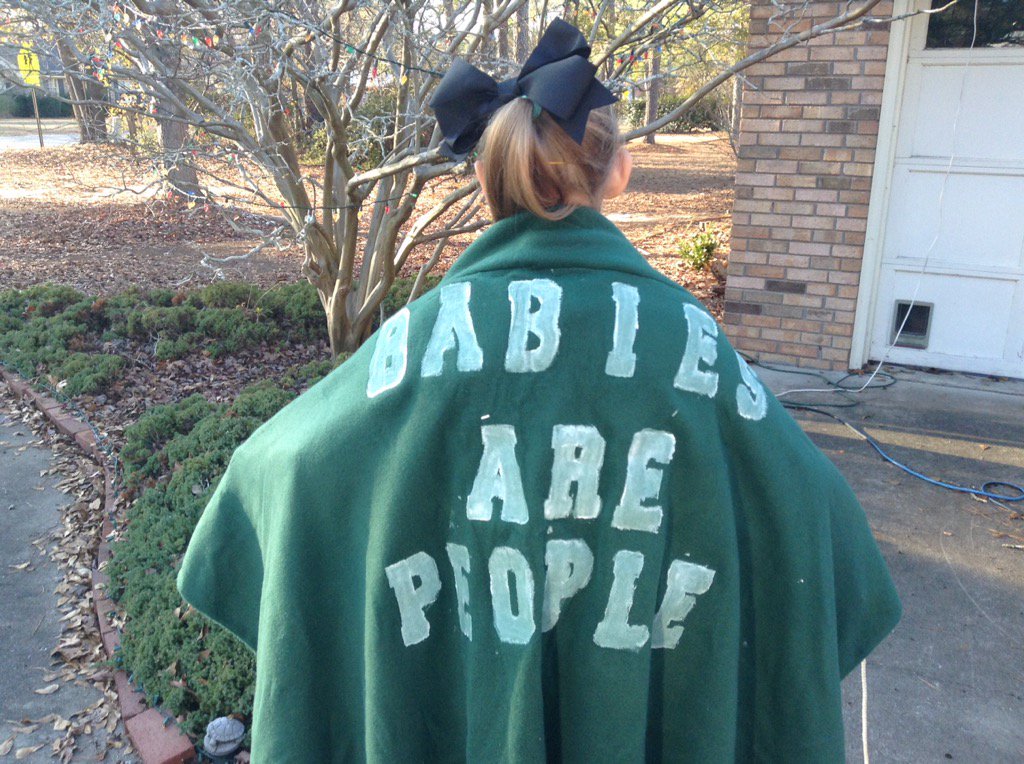
If you get tired of carrying the signdrape it over your shoulders like a cape, stash it in the baby’s stroller, or stuff it in your backpack.  It’s lightweight and compact.

If you get cold, wrap up in your sign for warmth.

If you have to sit on the ground during 5,000 speeches, your sign is also a blanket.

If the baby is breastfeeding, you can use the sign to cover that dreadful gap by your waist you failed to anticipate, and which does not feel invigorating outside in the cold in January.

If the kids are boredthey can do parachute games with the sign.

If your preschooler’s head keeps bonking against the window as he falls asleep on the way homefold it up and wedge it between his head and shoulder.  (Remove the rope first, thanks.)

If your house is so small you have no place to store your sign from year to year:

  • Keep it in the car as a lap blanket in the winter and to cover your steering wheel in the summer.
  • Hide it between your duvet cover and your quilt.
  • Fold it up and stuff it in a small pillowcase and use it as a pillow.
  • Hang it up in your living room to nip in the bud obnoxious political conversations.

You’re welcome!

Tip: Don’t argue with someone sporting one of these.


Old Links for the New Year

Backstory: I’m doing some testing on this blog and needed a reprint to run so I could check what happened.  I searched “New Year” at my Patheos blog and dredged up a post which contained these two links, still of interest:

1. At CatholicMom.com in December 2014 I wrote about a Gospel passage I never quite grasped until the events literally happened to me.  And then I got it.  Read the whole thing, and then you’ll know the context for my summing up:

Is there an area of my life where I’m clinging to a past identity? Allowing what I’ve done to define me? To condemn me? What can I do, right now, to become a person who is no longer defined by that past?

When you get to mid-January and your resolutions have already fallen apart, this is what you fall back on.  This is what your efforts are about.  Every minute of your life is a new minute.

2. [Jim A., this is the book we talked about the other week.] If you live someplace with people in it, there’s a book you might find helpful. At New Evangelizers I review The Culture Map by Erin Meyer.   It isn’t what you think it is.

My background is in business and in international studies, and over the years I’ve looked in on a number of “diversity”  type presentations.  Usually they boil down to a few funny stories about what your brandname means in Chinese and an admonishment that we all need to get along and celebrate our uniqueness, pass the baklava and let’s sing a Polynesian folk song.  This book is completely different.

Getting along with others isn’t the highest ideal. But it is good for you to try it sometimes.  Take a look at the book.

erinmeyer_cover_splash-220x300

Cover image for The Culture Map courtesy of ErinMeyer.com.


And a third link, bonus: The top result of my search at Patheos was this article: Gender Stereotyping is the Hot New Thing.  I enjoyed writing that one!

There’s a Saint Out to Get You This Year

If you don’t already know who it is, go to the Saint’s Name Generator and let some holy soul pick you for 2017.


The first year I tried this, I got St. John Bosco.  It was an obvious.

The next year, St. Matthew.  The need was clear, though I’m not convinced I kept up my end of things.

Last year, St. Andrew.  He works in obscurity, but work he does.

And then there’s this year, 2017.

So about that Rosary thing . . .

If you aren’t already familiar with the story of how I accidentally joined the Legion of Mary, you can read that story here.  An excerpt:

I’d never even heard of the Legion of Mary.  But this lady was fast.  She had my name on those forms in an instant. There’s the x for your signature, here’s a copy of your prayers to say every day, and don’t worry, it’s not a mortal sin if you miss a day, but do keep up with it.

“But I don’t go to this parish,” I told her.

They weren’t picky.

I signed.  And then I had to go home and explain this to my poor husband, a protestant who believed in neither the Blessed Sacrament nor prayers to Mary.  Oops.   Luckily he recognized the swift hand of God in answering my prayers for a better prayer life, and if it made no sense to him personally, who was he to argue with God?

And who am I to argue either?

That was all great until, as I wrote in 2015, things began to get complicated.  It is difficult to pray the Rosary (or any other talking-prayer) when you get light-headed when you talk.  The hagiographers won’t have any work to do with me, because I’m not one of those saints with heroic perseverance.  After a long period of trial and error I finally decided to sub out the Office of Readings if I couldn’t reasonably pray the Rosary, since that’s far easier to pray along with silently.  It’s reading.  They put the word reading right there in the name of it.

(I thought about making myself a rosary to read. Like a slide show or something. But then I didn’t.  I guess I should do that.  And yes, I tried apps and things, but nothing suited.)

So then, as I wrote the other day, I got better again!  Woohoo!  Which means that I transitioned, slightly unaware, from World’s Worst Auxillary Member of the Legion, But She Has an Excuse to WWAML, No Excuse.  I had forgot I could do this thing again.

But you know what?  God didn’t forget, and neither did this other guy.

Enter Rosary, Stage Left; Saint, Stage Right

Two big things happened in the last weeks of December.  I can’t remember which happened first.  One was that in the course of cleaning out the house, I came across the stunningly beautiful rosary that a friend had given me as a gift some years ago.  I used to pull it out for the Easter and Christmas seasons, but I’ve been slack about keeping up with liturgically-timed theme-changes lately, and honestly I had sort of, I’m mortified to admit this, forgotten it.  But it pushed its way in front of my nose before Christmas, you betcha.

Then I forgot it again, because it was still Advent.  I know!  But it gets worse!

Meanwhile, my boss here at the Conspiracy posts that she got St. Andrew for her 2017 saint.  He’s well-used among Conspirators, but still in good shape.  So naturally I had to go compulsively find out who my 2017 saint would be, even though it was still firmly 2016, but you know, Facebook.  Must click the link.

So I go, and I pray briefly, hit the button, get to the screen which tells you to pray, and I pray again.  A Hail Mary this time.  Hit the second button:

St. Louis-Marie Grignon de Montfort.

If you are in the Legion of Mary, you are now laughing manically and thinking about wiping up the coffee you just spewed all over your screen.  Sorry about that, maybe you should read the blogs of more reputable members.

The Case of the Unblessed Rosary

So I was officially put on notice.  No shirking in 2017, not for me.

Meanwhile, I again discovered that gorgeous rosary I’d re-forgotten, but had cleverly put on a shelf where I’d stumble across it more reliably.  The second time, I remembered something else: I’d never gone and gotten that rosary blessed.

There are two reasons for its heretofore unblessed state:

(1) My friend who gave it to me is not a Catholic, she’s just an extremely thoughtful and generous person who had this beautiful thing she knew I’d treasure made for me.

(2) At the time I received it, I had no idea rosary-blessing was even a thing.  No one tells you anything when you’re Catholic.  You can go years and years not knowing all kinds of stuff “everyone knows.”   Problem I might rant about another day, but for now, on to the happy ending.

So I’ve got St. Louis M. breathing down my back, a forlorn rosary dying to be put to its proper use, and hey, the year begins with the feast of Mary, Mother of God.

So yes, even though Father was miserable with a cold today at Mass and it pained me to ask him to say one more thing with that throat of his, I totally hauled that rosary out and had it blessed.  And then I went home and used it.  1 down, 364 to go.

Get yourself a saint if you haven’t already.  Happy New Year!

File:Людовик Мария Гриньон де Монфор.jpg
You could do a lot worse than having this man on your case.

Artwork courtesy of Wikimedia, Public Domain.


If you read this blog via e-mail or feed reader, or if you have Ad Block ensabled on your browser, FYI: Among our sponsors here at the Catholic Conspiracy are people who make and sell rosaries. If you’re in the market for Catholic or Christian-friendly goods and services, do kindly see if any of our sponsors are offering what you’d hoped to find.  Thanks!

Should You Try to Lose Weight?

It’s resolution season, and for reasons I can’t explain, I keep ending up in conversations about weight loss.  It might be because we live in a society that sells an obsessive preoccupation with a particular standard of beauty to a populace notoriously unable to achieve that standard.  Hence a large number of us yearn to live up to an ideal we are nowhere close to meeting.

Thus: Unhappiness.

If you are one of the unhappy people trying to decide what to do with your body this year, here are my three thoughts.

#1 Work on Your Soul First

I don’t say ignore your body, see below.  But let’s remember what your body is: Your body is the way your soul expresses itself.  You are a body-soul sandwich, the two are inseparable, and thus if you don’t take care of your body (see below) you hamper the working of your soul.  But the soul directs the body.  The work of the body is to communicate the soul to the world.  Therefore, if you have a perfect body and a trashy soul, your body is just going to strew garbage.

You don’t want that.

As it happens, one of the means of caring for your soul involves caring for your body — the two are, after all, inextricably linked.  But if you have to choose between devoting your limited energy primarily to making yourself all shiny and buff on the outside or tending to the serious spiritual problems you’ve got going on inside, tend to the spirit first every time.  Do that and the body will start to follow along — it’s attached.

#2 Do You Really Need to Lose Weight?

There are two categories of people who think they need to lose weight:

(A) People who do not need to lose weight.

(B) People who do need to lose weight.

I have no idea which one you are.

If you took a poll of friends, relatives, and physicians, you’d probably get a variety of answers — even if you inhabit the very portly or very slender end of the spectrum.

To complicate matters even further, there are some people who determine they need to lose weight, so they change some aspect of their daily habits and thus succeed in achieving long-term weight loss.  (Examples: Rebecca, Erin, the other Jen F.) There are other people who follow the same exact steps that worked for so-and-so, with the same amount of diligence and self-denial, and do not achieve the same results. There are yet other people who try ten different things before they finally figure out the one that works.  There’s not much way of knowing which group you’d fall into.

Therefore, after you’ve done #1, I recommend skipping straight to #3, which will hold you in good stead and save you all kinds of anxiety in the meantime:

#3 Work on Being Healthy and I Mean That For Serious

I am not your girlfriend who always says “supportive” things.  I am your mother who cares about your well-being, and who is also ready to barge in and claim your rights for you:

You deserve to be as healthy as you can reasonably be.

Now there are a lot of horrible things going on in your life that are getting in the way of that.  People steal your protein bars and stuff your cabinets with sugar-coated Doritos.  Your boss threatened to fire you if he caught you exercising.  You have an evil fat-producing tumor in your rear.  You’re allergic to fresh air, sunlight, and all vegetables.

I exaggerate, but I don’t kid.  We all have things we cannot control, and other things that are hard to control, that make it more difficult for us to take care of ourselves the way we ought.  We all have things that genuinely prevent us from being able to make ourselves as healthy as we’d like.

So accept right now that you might not be able to be as healthy as you want to be.  Furthermore, accept that being as healthy as you can be is going to require overcoming some significant obstacles.

But don’t, therefore, cheat yourself of that which you both deserve and can realistically have.

It isn’t, after all, just about you.  By taking care of your body as well as you are able, you allow your soul to work as well as it is able. And that means you are able to do good things for other people.

***

Spare notes for people who don’t have a clue where to begin:

I’m loathe to make specific prescriptions on what as healthy as you can be will look like for you.  I’m not your doctor, and anyway doctors disagree on what the best course of nutrition, exercise, and so forth looks like.  But if you know things are not well with your body and you aren’t sure where to start, here are my three thoughts on how to make a beginning.

Visit your doctor.  There are a lot of health problems, piles and piles of them, that can cause fatigue, weight gain, lethargy, depression, exercise intolerance, etc., etc., etc.  There’s no sense beating yourself up because you can’t achieve xyz health or fitness goal when it turns out all along you needed to be treated for an underlying medical condition if you were ever going to make a go of it.

Pick a middle-of-the-road book on health and nutrition that’s not about dieting, and is about eating real foods.  Two that get good recommendations by a broad cross-section of motivated-but-beleaguered readers are The Perfect Health Diet and The Wahls Protocol.  I don’t say these books will be exactly what you need forever and ever amen.  You may find you need to blatantly ignore some of the advice.  But if you are currently living on Frosted Flakes and haven’t got a clue whatsoever, both of these sit midway among various approaches to health and nutrition, and provide a starting point from which you could then make adjustments.  There are other similarly good books you might like better, I just haven’t read them.

Readers, if there’s a book or website you’ve found helpful in showing you how to realistically improve your health, please share over at the Facebook discussion group for this blog.

Start somewhere, and then adjust and improve bit by bit.  Maybe you’ll be one of those people who gets instant, perfect results with the first thing you try.  Congratulations and please hush your mouth.  Most people have to do some experimenting to find out what works well for making their bodies as healthy as possible.  Your body is unlike any other, and your life is unlike any other, so the only way to take care of yourself is to just keep trying to take care of yourself.

But regardless of how you proceed, here’s your message for the coming year: God doesn’t make garbage.

He didn’t make you to be treated like garbage.

He made you to be loved and cherished.  When He said, “Love your neighbor as yourself,” He necessarily implied that if you don’t love yourself, you aren’t going to be any good at loving your neighbor either.  Taking care of your body is a way that you serve God.

 File:The one man power in our jury system LCCN2011661381.jpg

Artwork: Joseph Keppler [Public domain], via Wikimedia Commons.  That’s a “P” in the word Puck, just FYI.