Making the Mass Present in Your Soul When Your Body is Absent from It

I want to talk about making use of the interior life.

For me, and sometime soon I will lay out the whole long story, the Eucharist is the center of my faith.  No matter how miserably I’m spacing out during Mass, from the moment of the Sanctus I suddenly wake up to God; from there the consecration, the Agnus Dei and fraction rite, Ecce, and finally my own reception of the sacrament are when the Mass really does something life-changing for me.

Y’all wish that change would last a little longer and be a little more visible in my life, but to God a thousand years is a like a day, so hang on, He’s working.  This is the time of week (or time of day, when I can get it) that I am most aware of that work happening.

Therefore having to not go to Mass is something I dislike intensely.

Reading prayers, even very good prayers, or watching the Mass on TV are not the same.  They can be valuable, but I don’t love them and I don’t get the same sense of God’s presence and intimacy apart from the Mass.

And yet sometimes I have to not go to Mass.

You might be in this situation right now, and you might be struggling with that reality, because you want, more than anything, to be with our Lord in the holy sacrifice of the Mass.  So I’m going to talk to you about my interior life, and maybe it can help you with yours.

Slacking vs. Slaking

I can be a pretty lousy Catholic.  Everything I am going to say does not apply to situations where I’m spiritually slacking.  There are times when I let myself get so wrapped up in the delusion of being “self sufficient” from God that what prayer I do manage, what obligations I do fulfill, are not about intimacy with the Lord.

But, fortunately we have the Sunday obligation, and the Mass does its work on me, and so I can count on most weeks getting some spiritual first aid by the time the consecration rolls around, even if I’ve been committing low-level spiritual self-harm all week long.  And of course some times I am, in fact, seeking God throughout my week, and taking time to be with Him, and that’s the spiritual state I’m going to be talking about now.

See, when you are seeking God, if something happens that keeps you from Mass, your soul can be disposed to receiving Him even when you are separated.

This is a mystical thing, not a theological treatise, so don’t get hung up on vocabulary.  I am talking from the point of view of my lived experience, and if you would like to translate that into precise definitions of this or that category of prayer, you can do that.  I’m just going to tell you what I know.

And what I know is that when you are thirsting for Jesus in the Holy Eucharist, the Lord will slake that thirst.

How to Be Not Afraid

This is the thing that has worked for me, so if you are now facing the absence of the sacraments and that fills you with anxiety, try this thing:

Mentally put yourself there in the sacrament.  If it’s the Eucharist, mentally put yourself in Adoration before the Lord.  See, feel, hear, smell, taste in your mind that moment when you and Jesus are together at Mass.  If it is confession you cannot access, as you make your act of perfect contrition at home, see, feel, hear, smell, taste in your mind that moment when you and Jesus are together in Confession.  The scene or the thought or the quiver in your gut that you experience will be unique to you, so I’m not going to give you too many words of instruction.  Just mentally try to make present that moment of spiritual lightning that strikes, or that wave of spiritual refreshment, or that warm, powerful embrace of consolation, that in the past you have felt when you diligently seek the Lord in the sacrament.

I don’t have your brain.  Maybe there is a hymn, or an image, or the wafting scent of incense, or some other tangible thing that helps you make your experience of the sacrament again present to you.  Maybe it is the position of your body.  Maybe it is the memory of a particular person who touched you profoundly at a time when you received the sacrament — a priest’s advice in the confessional, or the lady in the pew who held your hand at the sign of peace, or whatever it is — there could be some particular memory that helps you re-call, re-summon, your experience of the sacrament.  Don’t be afraid if it’s something weird.  Maybe the wood of your kitchen table reminds you of the wood of the pew and somehow that’s your thing.  I don’t know what crazy way God has put together the connections in your brain.

But figure that out.

And then when you are saying to yourself, “I hate that I can’t go to Mass on Sunday,” or whatever it is that you are missing, stop and take some time to mentally make present that sacrament. Allow yourself to experience it again.  Allow God to bring to you, right in your bed or at your desk or at your kitchen sink, the grace that you experienced before.

Time with an Infinite God

The thing is that though we live in time, God lives outside of it.

God is able, with your willingness and cooperation, to deliver back to your awareness the grace that He bestowed on you already, about which you have forgotten.  He who knew what would happen today, and tomorrow, and three weeks from now, has poured out on you all that you need to survive this time of desolation.

I don’t mean that this is a substitute for the sacraments.  I don’t mean that if you ought to be going to Confession today or Mass today, and though you could obey the Lord’s call, instead you plan to sit in your lounge chair and surf the internet, that you can just sub out thirty seconds of imagination and prayer for the Lord’s desire and command for you to find Him in the sacrament.  No way no how.

But if for some reason (perhaps acting on obedience to your bishop though you do not agree with his reasoning, and yet you know very well his authority is divinely-ordained, or perhaps acting in justice towards those to whom you owe care and protection) you are kept from the sacrament you desire, I do know that in those times, the Lord can supply what is lacking.

File:William-Adolphe Bouguereau The Virgin With Angels.jpg

Artwork: William-Adolphe Bouguereau, The Virgin With Angels, courtesy of Wikimedia, Public Domain.

COVID-19 Mind Games II

[Quick update: Fr. Marcin died this morning.]

I’ve had this weird on-and-off cold over the past week.  Sore throat and headache Tuesday, perfectly fine Wednesday and Thursday.  Slight cough Friday morning, then fine all day.  Fine Saturday.  Woke up today with a definite sore throat and runny nose.  So . . . any other year, it would be no big deal.  Not even on the radar.

Meanwhile, an interesting bit of science-ness via Trevor Bedford confirms what many of us have suspected, that in the absence of widespread testing (S. Korea being a counter-example), there’s a significant delay between when the virus first begins circulating in a community and when it is finally recognized in the form of serious cases that get correctly diagnosed. Which causes one to think: Is my child’s runny nose just another round of the sniffles, or are these SNIFFLES OF DEATH?

And thus a surreal moment for my youngest child, when I told her that no, I would not be allowing her to pack into the pews with all the old ladies at Mass this morning, but yes, she may still go mountain biking with her father this afternoon.  Unheard of happenings in this house.

My logic? The trees will be fine, whereas we do not need the backbone of the American church getting infected with who-knows-what.  Think about this: If you unwittingly kill off scores of old church ladies . . . Who’s gonna do the funeral meals?  Who’s gonna get those altar linens CLEAN? Who’s gonna torment Father while the rest of us are distracted with pre-retirement busyness and can only whine and scold on evenings and weekends?

***

Even in a “young” parish, a disproportionate share of the load, lay and priestly, falls on older shoulders.  When we received the news this morning concerning Fr. Marcin Zahuta (our son attends his parish), SuperHusband asked, stunned, “But isn’t he young?”  Weeellll, dear . . . I don’t know his age exactly, but he’s at least as old as us.  Turns out if you have adult children, then you might not be so young anymore.  Fr. Marcin was already well-established as “that young priest” who wasn’t so so young way back when the boy was attending Catholic summer camp in elementary school and Father was the chaplain.

Thus my thesis: If you love the Church at all, do what you can to slow the inevitable so you don’t overwhelm your local hospital.  We have an incredible amount of medical technology at our disposal to deal with pulmonary diseases, we have skilled healthcare workers who excel at helping marginal lungs hold it together, but we don’t have magic.  We can’t snap our fingers and quadruple our capacity for treating highly infectious patients with extreme respiratory distress.

Hence the mind game.  Am I being ridiculously paranoid, or am I just doing my civic duty?  I don’t know.  We’re muddling through, refraining from blatant acts of infectiousness like sneezing on elderly people but not going into complete isolation over the sniffles either.  Maybe we’re not being careful enough.  You don’t know.

***

Meanwhile, my brother called the other day to ask about bringing his family to visit over spring break.  (Yes!  Please!) They’d be flying, which is a germy proposition regardless of hot new respiratory viruses, but I don’t think for healthy, low-risk travelers the threat of infection is the chief concern.  The big question mark is whether you’ll accidentally end up quarantined.

Worse things could happen than getting home from a trip only to be told you’re now on forced-staycation because you traveled through a freshly-declared epidemic zone, and of course you’ve got no milk in the fridge because you were just out of town for a week.  The more serious question he needs to answer is . . . what if my town is that place, and he’s here when the airlines quit servicing our nearby airports, and neighboring states shut their overland borders, and he gets stuck with us for a month?

He’s a brave a guy, but how brave?

If this thing goes pandemic the just the right way, we could end up with some genius help finishing our construction project.

Me with my laptop on a folding table in our unfinished garage / office.

Our Daily Photo Penance: Evidence my office needs drywall, plumbing, HVAC, and oh, and um, lots to be done outside with dirt and pavers.  Family reunion time for sure. 

Related: Darwin Catholic has a superb reflection, “Life in Uncertain Times.” Worth your minutes.


How to Look Like a Saint While Heading to Hell*

Head’s up: This post is not g-rated, and it does dissect the allegations in a real abuse case.

To all but those few who knew his secrets, the news about Jean Vanier comes as a complete shock.  (Count me among the shocked).  How can this guy who did so much good — a guy who was seriously being considered for canonization — have been guilty of such crimes?

This is a question we can’t just set aside as impossible to answer.  It is not impossible to answer, and since sin didn’t go to the grave with this latest scandal, we have a responsibility to understand and act on the answer.  So, unpleasant though it be to launch into this topic right now, here are the three things that make it possible for an evangelist to live a double life.

#1 Stealth Predators Test the Waters

It doesn’t matter whether we are speaking of consensual affairs among willing adults or the most nefarious rape, if you want to live a double life, you have to move carefully.  Read this account of an abuse-survivor’s story to see how it’s done.  I chose this story in particular because it shows you exactly how a predator avoids detection (though in this case he got caught sooner rather than later), because we’re looking at a case where the predator tested the waters, fish got away, man had to move on.

What to note:

  • The predator (priest in this case) starts by building a trusting relationship.
  • Early on, the idea of secrecy or covert-ops is introduced (“tell your mom you’re seeing me for spiritual direction”).
  • The first abuse is an action that can be explained away.

Hence the insistence by the predator’s superiors that the abusive encounter was merely a “boundary violation.”  Let’s be clear: A man pressing his erect penis against a woman’s body, even through the barrier of clothing, is engaging in sexual activity.  No decent man will know he has an erection (this is not something men are unable to detect) and choose to physically press his pelvis against the body of a woman who is not his wife.

Legit foreplay for a married couple.  Not legit under any other circumstance, and no sane adult man is going to let a teenage girl become aware he has an erection by physically putting her in contact, even through clothing, with that part of his body.  Nope.

And yet we see in this sample case that the behavior gets excused.  Why? Because it was chosen by the predator for the ease with which he could wiggle away from the charges.  The girl was mistaken.  Either she doesn’t know what she’s talking about (because how does a young teen know what an erection is), or if she does know, then obviously she’s a hussy and she’s making a false accusation — bad family, dontcha know.  I’m concerned someone might be abusing her, and that’s why she’s acting out.  And gosh, I shouldn’t have hugged her, I shouldn’t have let her sit on my lap, it’s just that she reminded me so much of my niece, and she really seemed like she wanted a hug, and listen guys, I realize I had a lapse in judgment.  I’m so sorry.  I realize my mistake, and I’m not going to let it happen again.

A predator who gets away with his or her crimes is someone who operates carefully.

#2 Toxic People Choose to Surround Themselves with Enablers

Obviously the predator has to move beyond those initial tests.  So how do you get away with your abusive behavior when sooner or later word is bound to get out?  You do this by making sure that no one close to the facts is going to report.

To a toxic person, there are two types of people in the world: Those who will tolerate the abusive behavior and those who will not.  The non-tolerators are systematically removed from the toxic person’s circle of friends.

Much of this is self-chosen by the healthy person.  If you have a boss who underpays and overworks, the simplest thing to do is look for another job.  If that friend is always dragging you down with gossip and drama, you start hanging out with different friends.  If a relative is taking advantage of your generosity, you set firm boundaries.

In ministry, self-respecting volunteers and paid staff don’t stick around long if toxic people are in charge.  They move on early. Gradually, without ever having been caught at any serious crime, the predator-in-charge finds him or herself surrounded only by those who will, for whatever reason, look the other way at sinful behavior.

And of course the career-climbing predator has additional tools available to help clean out the org chart.  Whereas a holy person will not lie to sabotage a fellow employee, a skilled predator is well able to build a case against those who need to be eliminated.  An insinuation there, a careful retelling of the facts here, and next thing you know that volunteer who wouldn’t shut up about actually following child safety procedures is out the door.  Once you are in charge of a ministry, it’s easy enough to find some pretext for making a staffing or organizational decision to unload the contingent who gets in your way.

Reality to consider as we pray for our priests?  It is almost impossible for a pastor of souls to know what is really going on in his parish or diocese.  Unless he makes a powerful effort otherwise, his life is going to be saturated by the company of people who revel in winning the game of being part of the priest or bishop’s inner circle, and people who want to play that game are not healthy people. Thus even a holy man is likely to end up enabling toxic behavior — and it’s hard to be a holy man.

#3 The Devil is Prowling and Sinners Lie to Ourselves

Allow me to quote the St. Joseph’s Baltimore Catechism: Venial sin is worse than the measles.

As an expert sinner, let me tell you, it is very, very easy to talk yourself into sin.  Venial sin, mortal sin, all sin.  The smarter you are, the better you can be at making up rationalizations for why this sin here is not a sin at all, and that one over there is maybe just a teeny tiny sin, especially after you consider all the mitigating circumstances.

The degrading nature of sin is plain as day to those who aren’t caught up in the self-built snare of lies used to justify the sinful behavior. That’s why sin hates daylight.  When you suspect you are sinning, you work hard to hide to the sin.  Sometimes you do this by acting in secret; other times you camouflage the sin so it passes as no-big-deal. If it must be discussed, you come up with words and phrases that make the sin sound like something harmless, or perhaps even something healthy.

This does not mean that adultery is just the same as making a frowny-face at your husband when he interrupts your phone call.  This does not mean that abusing a child is the same thing as that time you let the kids have brownies for dinner.  What it means is that the more intentionally we engage in the battle against even our smallest sins, the more easily we can understand how people who are dedicated to a life of good can also be deceiving themselves into committing serious evils.

The teeny-tiny devil who helps us justify our little sins is just a miniature, cute-faced version of the big devil haunting the peripheries.  To commit a little sin, tell yourself a little lie. To commit a big sin, tell yourself a big lie.  Same process.

There is no easy solution to all this.

What we want is to be able to say, “Now that I understand how this happens, I can prevent it from ever happening again!”

Not so much.  All we can really control is our own behavior.  We can choose not to be complicit in corrupt activities.  We can grow in our own holiness so that we are more aware when someone else is pulling out the excuses to justify a sin. We can teach our children and other souls in our care how to recognize and avoid sin in ourselves and others.

To the extent that we have authority to do so, we can take steps to battle against the structures and excuses that enable serious sin to flourish.

Meanwhile, free will’s a bear.  Be as good as you can, help fight evil where you can, and then fast and pray.

That’s what you can do.

File:Bataille Waterloo 1815 reconstitution 2011 cuirassier.jpg

Photograph: French cuirassier during a re-enactment of the Battle of Waterloo, courtesy of Wikimedia CC 3.0.

Related: Repentance, Mercy, and Prudence

*Lord willing, Jean Vanier repented of his sins and is now enjoying the delights of Heaven.  May we all benefit from the bountiful mercy of Jesus Christ who will do anything He can, even die for us, that we each might be saved from our two worst enemies.

Need Your Help: Stories of Equal Access

I need your help with getting a door unlocked.

I’m a parishioner (and at last check parish council member) at a large and historically-significant parish.   Thanks to renovations over the years, there are three wheelchair-accessible entrances feeding the parish church.  Unfortunately, since November of 2017 all three of those doors have been locked.  The only way to get into the building during Sunday Mass or Saturday Confession is to either walk up a short flight of stairs (seven if I counted correctly) or wait around on the sidewalk hoping to flag someone down who will go unlock an accessible door for you.

Unfortunately, the pastor of the parish doesn’t seem to understand that it isn’t okay for someone with a disability to have to make advanced arrangements in order to be able to get inside the building for Mass or Confessions.  He’s otherwise a fairly stand-up guy, but he seems genuinely shocked that I would be angry about this issue.

I’m not above launching a massive public shame-storm, but that’s a weapon of last resort.  What I’d like your help with is attempting to show Father (and I tell you again: he is otherwise a pretty sane guy) that equal access matters.

Here is a form where you can share your story.  Can you share with him an example (or multiple if you’ve got them — fill out as many entries as you’d like) of how equal access, or lack of it, has affected your life?

My plan is to pass on to him your stories so he can see, person by person, just how painful it is to be the one stuck out on the sidewalk wondering how you’ll get in.  I’ll also put in a Mass intention for the collective intentions of those who share their stories (so Father L. gets to pray for you, cause that’s his job), and of course I’ll pray for you individually and I think he will too.

I’m not looking for angry.  He’s gotten plenty of angry from me, and believe me, I’m not as nice in regular life as I am on the internet.  I’m looking for your personal story of how being able to participate in parish or community life made a positive difference for you or someone you love, or how being excluded by needless barriers did the opposite.

The reality is that barriers keep people out.  After a year and a half of locked doors (in a previously accessible parish), the only regulars with disabilities are the few who are okay with the new status quo as second-class citizens.  Everyone else has disappeared.  If you showed up as a tourist (the parish receives many out-of-town visitors at weekend Masses), you’d follow the signs to a locked door and maybe succeed in waving someone down, or maybe just give up and move on.  As a result, Father L. no longer sees the people who are most affected by his decision: You’re all gone.

I need you to make yourself visible to him again.

Thank you so much.

I’ll post updates as I get them.  Also: If you choose to let me share your story (and only in that case — opt in or your story remains completely private), I’ll pick a few to post here and elsewhere, so that your voice gets heard far and wide.  Thank you!

File:No Accessibility - Alternative Handicapped Symbol.svg

Image: No Accessibility Icon, courtesy of Wikimedia, Public Domain

Towards an Authentic Spirituality of Confirmation

I wrote to the DRE at the start of the school year, explaining that my teen wanted to be confirmed but that I was in the middle of a new job that was requiring 70-80 hour work weeks, so I really *could not* be the hand-holding parent going to a bazillion meetings and all that.  I requested that the parish come up with a formation program my teen could complete without parent attendance, and what with it being she, not I, getting confirmed, it seemed reasonable.

Despite the steady nagging of teens to become “adults in the faith,” the parish struggled intensely with the idea of working directly with a teenager.  I can get this, because I work directly with young persons, so I know that they are not universally organized and conscientious.   Teaching children to become adults requires risk-taking and persistence.  DRE’s thus tend to have an Augustinian wish: Give these teens responsibility, oh Lord, but not yet.

***

Over at the Register, Jason Craig writes “Why Confirmation is Not a Mere Rite of Passage.”  I give it a hearty amen in part because  I have shown up to a couple parent Confirmation-prep things lately, and apparently the indoctrination at religious ed on the “becoming an adult in the faith” is so strong that when I whispered to my teen a corrective to the presenter’s assertion that the sacrament of Confirmation was about you as a teen confirming you wanted to be Catholic, she whispered back, surprised, “It’s not??” I let the deacon feel my ire.  The mother is not amused by pseudo-theology.

The mother is, however, grateful.  If you’re going to lay into the parish staff for their irresponsibility, you have to be willing to do the work to offer something better.  We came home from that dreadful formation meeting with a challenge: What is the point of Confirmation?  It’s all well and good to say it gives you the Gifts of the Holy Spirit, but what does that mean?  How is it different from Baptism and the Eucharist?

A few days contemplation bore much fruit.  My husband and I, and hopefully the kids as well, found ourselves moved very deeply as we considered with awe the reality of this sacrament which, described imprecisely, is for your relationship with the Holy Spirit what the Eucharist is for your relationship with Jesus Christ.  That intimate union, that indwelling, that receiving of life . . . to speak of the action of the Trinity is risk material heresy, but whoa!  You want to shake a few shoulders and shout at the bishop with his well-meaning video for teens DO YOU HAVE NO IDEA WHAT IT IS YOU ARE FAILING TO TELL THESE KIDS?!!  Tithing and church service are great, and yeah I’d like more priests too (though I want to find out if there’s a trustworthy seminary first), but seek first the Kingdom of Heaven, guys!  Confirmation is one of the seven great mystical things, and you are missing out terribly if you think it is just a glorified membership drive.

Fortunately, the sacrament doesn’t wear off.  Even if your parish has hidden the glory of the Holy Spirit under the table cloth of mandatory service hours, and your teen’s formation program consists of Catholic-brand career-counseling, God in His humility is waiting, like the preschooler behind the door calling out “I’m hiding come find me!”  Ignore the distractions.  Go into the quiet room where God dwells and find Him there.  He wants to live in you.  He wants to make you His home.  He wants to make His life your life.  You were made for this.

***
The children are taught to list the Gifts of the Holy Spirit when asked what it is they receive at Confirmation.  You’re supposed to say that, instead of “Green light for my quince,”  or “To get my parents off my back,” when they ask why you want to be confirmed.  There’s an awful lot of talking about the gifts, and using the gifts, and of course you had to work hard attending classes and doing service projects and writing papers in order to be allowed to have the gifts.

It is so much noise.  Blather.  Idiocy.  Too smart for your own good.  Ditch the growing-up talk, because it is a childlike faith that our Lord requests.  Children, unsophisticated, believing, accepting, are unafraid to ask for what Confirmation is: I want the Power of God to live inside me.

That’s more than enough.

File:A Taraxacum Ruderalia dandelion clock.jpg

Photo by Richard Bartz courtesy of Wikimedia, CC 2.5.

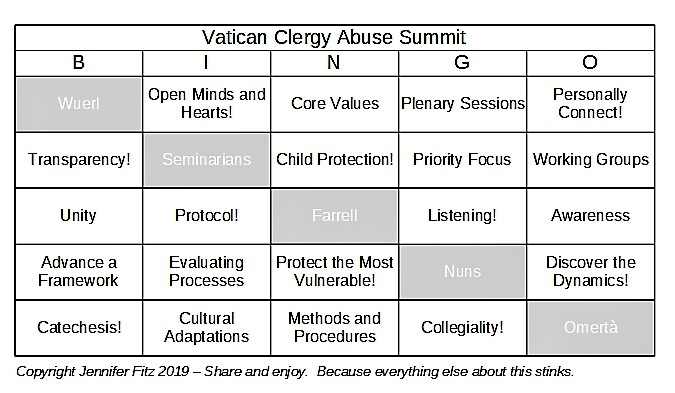
Vatican Clergy Abuse Summit Bingo

From the makers of that evergreen classic Bishop Press Release Bingo comes the game we’ve all been waiting for, Vatican Clergy Abuse Summit Bingo!

Unlike regular Bingo, with Vatican Bingo what doesn’t get said counts too!  Put your chips on the grey boxes at the start of the game, and you get to keep them there until someone starts talking.  Don’t worry, when the Vatican’s playing, you can be sure your chips won’t be extradited any time soon.

And lest you worry: The Vatican shut down the USCCB’s process last fall to replace it with this?  Fear not.  The USCCB wasn’t planning to talk either.

Manliness and a Perfect Funeral

Hathaway’s funeral was perfect.  Chanted Extraordinary Form Requiem Mass at the old but not old-old St. Mary’s church in Aiken, then procession to the graveside for a Melkite burial.  Nothing says “four last things” like a Dies Irae in the hands of a good cantor.

As our line of cars, lights on, hazards flashing, police escort, ambled down US 1 towards the cemetery, traffic of course made way.  But this is a land where funerals are still taken seriously, and even on the four-lane highway where there was no practical need to do so, most vehicles coming the other direction pulled to the side, stopped, and put on their lights, paying their respects.  You have no idea of it, I thought as I passed driver after driver putting life on hold for two minutes of stillness in honor of a complete stranger, but you are witness to the funeral of one of the world’s great men.

***

John’s daughter asked (shortly after his death) if I could speak at the funeral meal.  After the perfection of the funeral homily and the solemnity of the mass and burial, what I had prepared seemed woefully inadequate.  It also was not very gentle, but fortunately there was a line-up of nice friendly people to follow, including a dear friend with the gift for coming across as a big, chummy teddy bear while he reminded the audience of the value of redemptive suffering and the need for masses and holy hours of reparation.

I’m sure most people did not like what I had to say, but the one person it was written for thanked me for saying it.  Below is the text, with most of the typos removed.

***

When we try to explain the difference between men and women, we tend to resort to stereotypes.  We know that men possess, on average, more physical strength than women, so we use examples of large, muscular men performing heavy manual labor.  We know that men have an inborn, undeniable vocation as providers and protectors, so we reach for clear examples of those.  When we think of providers, we might give the example of a successful business owner, or an accomplished professional; or we might think of an ordinary workman or farmer putting in long hours at physically grueling labor in order to provide a simple but decent living for even a very large family.  We know that men are created to be protectors of the family and community, and thus we look to the sacrificial life of men who have careers in the military or as law enforcement officers.  These are not bad examples.  But they don’t get to the heart of what it means to be a man.

John Hathaway had the rare and excruciating vocation of showing the world what it means to be a man.

You could not look at John and think “typical big strong muscular man.”  (Though at times he astonished me at how strong he was.)  But what is a man’s strength for?  It is for serving God and serving his family.  John Hathaway used every ounce of his physical strength in fulfilling his vocation as husband, father, and Christian.  I remember him telling me the story of literally crawling to Holy Communion one time, so determined he was to receive Our Lord despite whatever parish he was visiting not noticing he needed the sacrament brought to him in the pew.  John was a wealth of medical knowledge – if I had a difficult medical question, he was on the short list of people I’d go to with such questions – because he was utterly focused on husbanding his strength, as the expression goes, so that he would be as strong as he possibly could be in order to serve his wife, his children, and God.

As a provider, John fell in the terrible predicament of those who are extremely talented but not in financially lucrative ways.  He was an English professor in a nation where adjunct professors sometimes literally live out of their cars because they cannot afford rent.   Many men find themselves in this position, willing to do whatever it takes to provide for their families, but thrust into overwhelming circumstances beyond their control.  The despair this can cause men is at times deadly.

John Hathaway deployed extraordinary determination and perseverance and ingenuity in figuring out, day after day, year after year, how to provide for his family.  And he did provide.  He absolutely embodied what it means for a husband and father to be a provider.

As a protector I want to talk about John’s role in defending his children’s very lives.

We live in a time when it is legally and politically and socially acceptable to say that John and Allie and Gianna and Josef and Clara should simply be killed.  They should never have been allowed to be conceived, for fear they not measure up to some ideal standard of human health.   Allie, the same Allie who has been a pillar of strength and a fount of practical help to Mary over this past harrowing week; the same Allie who is delightfully talented and devoted to sharing her talents with the community . . . is someone that even Christians will sometimes say, “it would have been better if she’d never been born.”

I would say John’s life work was one steady, undying protest against that evil.  He tirelessly spoke and wrote and worked to persuade the world that his children deserve to live.

This vocation of his was painful.  It was physically and spiritually exhausting. He deployed every spiritual and physical weapon at his disposal against the constant and at times overpowering despair and darkness that descended on his life.

I can recall at times literally thanking John for still being alive.  I thanked him for the depths of the agony he endured by dint of continuing to pursue medical care in order that he might, for as long as possible, be present in this life to his family.  I thanked him selfishly: I knew that death would be easier and more pleasant for him, and I knew that when that time came I would feel his absence profoundly.  John was a delightful person to know and to talk to and to be with.

In closing I want to commend Mary for her choice of a husband.  She has faithfully withstood no end of criticism for marrying a man who lacked the superficial traits that are idolized by our society.  But she has known what others don’t see: That she married a man who truly embodied manliness to its fullness.  He cherished her, he sacrificed daily for her and the children, and gave his life and every ounce of his strength to providing for and protecting his family.  He made his own and by extension their relationship with Jesus Christ his number one priority.  He was everything any man could ever aspire to be.

File:Iglesia de La Compañía, Quito, Ecuador, 2015-07-22, DD 149-151 HDR.JPG

The pale and fleeting beauty of the Shadowlands, as seen in the Jesuit church in Quito, Ecuador. Photo by Diego Delso, delso.photo, License CC-BY-SA.

On the Passing of John Hathaway

File:Jan van Eyck - The Ghent Altarpiece - Singing Angels (detail) - WGA07642.jpg

I woke this morning to check on the progress of the hurricane and saw the eye was headed straight for the home of John C. Hathaway.  I logged onto Facebook to see how the family was faring, and learned that John had died (as unexpectedly as John Hathaway could ever manage to die) in the early hours of the morning.  If you knew John at all, you would find it entirely fitting that a hurricane should do a flyover to pay its respects.

(If you knew John at all, you would know that he would rebuke me sharply for saying it, but also that Santo Subito! are the words that come to mind on his departure from this life.)

So here is something interesting:  Back in 1931, Pope Pius XI extended the feast of the Maternity of the Blessed Virgin Mary to the entire church. It had long been celebrated in Portugal on October 11, so that was the day established for the feast.  Therefore if you check Butler’s Lives for this morning, whether for your own edification or in order to note the auspicious nature of your dear friend’s day of death, you’ll see this quote:

But one thing in particular, and that indeed one of great importance, We specially desire that all should implore, under the auspices of the heavenly Queen. That is to say, that she who is loved and venerated with such ardent piety by the separated peoples of the East would not suffer them to wander and be unhappily ever led away from the unity of the Church, and therefore from her Son, whose Vicar on earth We are. May they return to the common Father, whose judgment all the Fathers of the Synod of Ephesus most dutifully received, and whom they all saluted, with concordant acclamations, as “the guardian of the faith”; may they all turn to Us, who have indeed a fatherly affection for them all, and who gladly make Our own those most loving words which Cyril used, when he earnestly exhorted Nestorius that “the peace of the Churches may be preserved, and that the bond of love and of concord among the priests of God may remain indissoluble.”

You can read the full text of Lux Veritatis here, and doing so would be a fitting way to commemorate Hathaway’s legacy.

(Vatican II, which opened on this day, moved the feast to January 1 . . . opening the slot for Pope St. John the XXIII who gave us that council.)

There are many other things to say, and I hope to say them later.  For now, please pray for the repose of his soul and the consolation of his beloved family, to whom he was utterly devoted in his vocation as husband and father.

Updated: Fellow Catholic Writers Guild member (John was a writer and member of the CWG) has set up a Give-Send-Go account for the family, to cover their funeral expenses and other needs.  Your generosity is much appreciated.

File:Retable de l'Agneau mystique (7).jpg

Details from the Ghent Altarpiece courtesy of Wikimedia here and here.

The #2 Thing Anyone Can Do to Help the Church

There are two myth-making forces at work in the McCarrick scandals.  One is denial.  Clinging to the idea that there are a few bad apples, and they are just so very sneaky and that’s why they got away with their crimes.

The other myth is that the good guys can fix this.  We imagine we can run over to Costco and pick up the plenty-pack of Accountability Spray, and with enough elbow grease the house will be squeaky clean again.  Everyone pitch in!

If the Church is a house, myth #1 is that the fridge is a disaster and needs to hauled to be the dump, can’t decide whether to fumigate the couch in the den or just burn it, and let’s rip out that musty carpet in the back bedroom — then everything will be fine again.  A few cobwebs and a squeaky staircase?  Typical old house.  Relax.

Myth #2 is that sure, we belong on an episode of Hoarders, but if we call in the team we can all work together until the junk has been cleared out and the walls and floors are all scrubbed down.

That’s not what we have.  What we have is extensive rot in load-bearing walls.

What does the rot look like?  It looks like this comment from the fabled orthodoxy-wonderland Diocese of Lincoln:

I’m glad someone has finally spoken about this.  A fellow-seminarian (now-priest) and I were tormenetd by MK’s [Msgr Kalin] behaviors for a long while.  Our experience was part of what led +Fabian to order that at least 2 people accompany MK on the stadium walks.  I wish it weren’t true, but it is.

What was happening is that Msgr. Kalin, who was both diocesan director of vocations and director of the University of Nebraska Newman Center, was molesting his students.  The former student explains:

Since you seem to be afraid to read between the lines, I will state it plainly: repeatedly asking to touch and be touched in inappropriate places, asking for “French kisses”, and doing these actions without being given permission — to say nothing of the entire grooming process by which these actions/gestures were normalized.  I finally said something after my friend walked into the chapel literally *shaking* after one of these episodes, because until then, I thought it was just me.  It was at that point I woke up to how twisted the whole situation was and had been for some time.  Now, think about the fact that this is coming from the person who made himself your confessor and spiritual director.

UPDATE: Here is an account of Wan Wei Hsien’s experience that provides a clearer timeline of events.

This is the same Msgr. Kalin who was the picture of a balanced commitment to priestly chastity in an interview for American Catholic: The Saints and Sinners Who Built America’s Most Powerful Church:

When I asked Kalin about homosexuality, he said, “I get to know a candidate pretty well before I recommend him to the seminary, and if I think someone is an active homosexual, I’ll take him aside and we’ll agree that the priesthood isn’t for him.  On the other hand, Bishop Flavin always said that he didn’t care what someone’s inclinations were, as long as he was sincerely committed to a chaste life.”

American Catholic by Charles Morris, p. 387

Predators cover their tracks.

A healthy, sane person would react to such betrayal with shock, despair, and disbelief.   If the lone-predator myth were true,  then when Msgr. Kalin’s deception was uncovered, a clear-thinking supervisor would do a thorough investigation and either exonerate the accused or determine the man was not competent for ministry.

What was bishop Fabian Bruskewitz’s solution to this problem?  Require seminarians to only visit their director in pairs.

That’s right: The bishop understands that the director of seminarians can’t be trusted alone in the room with a seminarian . . . but he still thinks the man is competent to direct the formation of the diocese’s future priests?

This is the behavior of people in abusive relationships.

***

Here’s an interesting article in that it shows you the shiny veneer of a dysfunctional family.  Compare the key players in that happy vocations story to the names in Rod Dreher’s efforts to dig out the facts on the Kalin case (quoted above).  Gives you pause for thought.

***

People in abusive or dysfunctional relationships behave in insane ways.  There is constant blame-shifting, avoidance of responsibility, and generating of excuses and distractions to cover over the real problems.  Anyone who tries to speak reason or point out real problems becomes the enemy.  The status quo must be preserved.  Everyone tied up in the abusive relationship has somehow come to believe that their safety is threatened if anything disrupts their twisted, tormented way of life.

So seminarians are sent to see their director in pairs.

A generation of priests in one of the most boomingly orthodox dioceses in the nation were formed by a notorious lecher who was left in office after his crimes were known to the bishop.

That’s not about McCarrick.  That’s about Bruskewitz.  Different theology, different politics, different dioceses . . . same problem.  All across the nation and around the world, whitewashed pillars of the church are decayed to the core with this rot of abusive and dysfunctional relationships.

***

I and others who have been writing about the McCarrick fallout get letters from church-workers, clergy and laity alike.  We get thanked for our open, outspoken coverage of the bishops’ failure of leadership.  And invariably there’s a coda: “I can’t say anything myself.  I have to be careful.”

Yes, I know about that.  I know about being pushed out of a parish ministry because I held someone accountable for a gross failure of common sense where child safety policies were concerned.  I know about silence and “discretion” that involves never, ever, speaking up with plain answers.  I know about people accused of sexual crimes against children threatening lawsuits if you share public information about the status of their legal case . . . even as they are in the process of inviting your own children to their home.

I know about that.

***

I also know that things are complicated.  I know that false accusations happen.  I’ve been the key witness in a case defending an innocent man against an egregious and absolutely fabricated, revenge-motivated accusation.  I know that decent people get overwhelmed in difficult situations, and we don’t always handle the moment in the best way.  I know that sometimes you are under the gun and you do something really dumb, and you regret it later, and you resolve to never do it again.  I know that sometimes you examine a situation carefully, and you still come to the wrong conclusion about the best way to handle it.  I know that sometimes you just don’t understand how serious a situation is, and you don’t treat it with the gravity it deserves.  Stupid happens.  It happens to all of us.

***

Here’s the difference between stupid and dysfunctional:  Healthy people don’t build their lives around defending and perpetuating stupid.

***

So what can anyone, in any state of life, do in response to the rot of abuse and dysfunction in our Church?

Of course #1 is to fast and pray.  You know that.  You don’t need a blog post about it.

The response that hurts is #2: You have to act like a healthy person.  You have to refuse to be part of the cycle of dysfunction and abuse.

The only way for the Body of Christ to be healthy is for members of that Body to be healthy.  The gangrene stops here.

***

That’s not fun.  It gets ugly fast, because the dysfunctional people will pull out every weapon they have to fight your insistence on sane behavior.  You can expect lying, evading, shunning . . . the works.

What does it mean in parish life?  It means you might not have much of a parish life.  It means that you might become the persona non grata, because you refuse to play along and pretend everything is fine.  It means you or a family member might be denied the sacraments.

***

Oh no!  In that case—

Think about it.  You’re afraid that if you refuse to sin, and if you refuse to be party to perpetuating sin . . . you’ll be cut off from the grace of God?

That’s not how God works.

How God works is that He rewards His prophets by having them thrown into a cistern.  He rewards His son’s obedience with the Cross.  But His grace is right there the whole time.

File:Dome Cappella Chigi from inside, Santa Maria del Popolo, Rome, Italy.jpg

Photo courtesy of Wikimedia, Public Domain.

Praying for Terrible Bishops

Up at the Register: How to Be Catholic When Your Bishops Are Not.  I am not gentle in this one.  A faith that depends on eyes-half-shut and pretending all is well in the Holy Catholic Church will not withstand the present onslaught, unless you’re extremely expert at lying to yourself.  I don’t think lying to yourself is a good option.

Meanwhile, let’s talk about praying for your bishop.  Here’s a thing to understand:  Your bishop was chosen for his cowardice.

Perhaps over the years you have wondered why your bishop seemed unable to accomplish much of anything.  You might have wondered why every statement out of the diocese was more watered-down than a glass of ice cubes on a summer afternoon.  You might have wondered why your parish and diocesan leaders seemed to find the clear and certain teachings of the Catholic faith just. so. difficult. to. praaaaactiiiiiiiiice.

Now we know.  It turns out that in the eyes of the Church’s top leaders, fecklessness in a bishop is not a bug but a feature.

With Cardinals like McCarrick at the helm, it’s a miracle the clergy accomplish anything at all.

Well, God can use that.

Because you know how God shows off? By doing His work through the crappiest instruments He can get.*

Are you a terrible person?  Then God can use you.  You can pray things like, “Lord, I am almost as wretched as my faithless, weak-kneed toad of a bishop, and so I know what dreadful danger he and I both face.  Indeed, were I in his shoes, I might be even worse than he.  After all, Satan hates bishops even more than he hates me.  Under full attack from the enemy, I’m not sure I’d last half an hour.  So if you could somehow spare us both from eternal damnation, and maybe even accomplish a few miraculous acts of virtue through us, I’d be most appreciative.”

Alternately, if you aren’t already praying from the Liturgy of the Hours, give it a look.  A sample from this morning:

Lord, listen to my prayer:
turn your ear to my appeal.
You are faithful, you are just; give answer.
Do not call your servant to judgment
for no one is just in your sight.

The enemy pursues my soul;
he has crushed my life to the ground;
he has made me dwell in darkness
like the dead, long forgotten.
Therefore my spirit fails;
my heart is numb within me.

I remember the days that are past:
I ponder all your works.
I muse on what your hand has wrought
and to you I stretch out my hands.
Like a parched land my soul thirsts for you.

Lord, make haste and answer;
for my spirit fails within me.
Do not hide your face
lest I become like those in the grave.

In the morning let me know your love
for I put my trust in you.
Make me know the way I should walk:
to you I lift up my soul.

Rescue me, Lord, from my enemies;
I have fled to you for refuge.
Teach me to do your will
for you, O Lord, are my God.
Let your good spirit guide me
in ways that are level and smooth.

For your name’s sake, Lord, save my life;
in your justice save my soul from distress.

Chicken Soup it is not.

***

Editing notes on the Register piece:

  • If I could do it over, I’d write “feckless simpering” instead of “simpering fecklessly.”  Sometimes we aren’t perfectly concise in our haste.
  • I regret that I did not write myself out a list of synonyms for the word “putrid,” as it occurred to me I should.  I woke up this morning with the stark realization that I had missed quite a few.

Well, that’s how it goes sometimes.  We live to write another day.

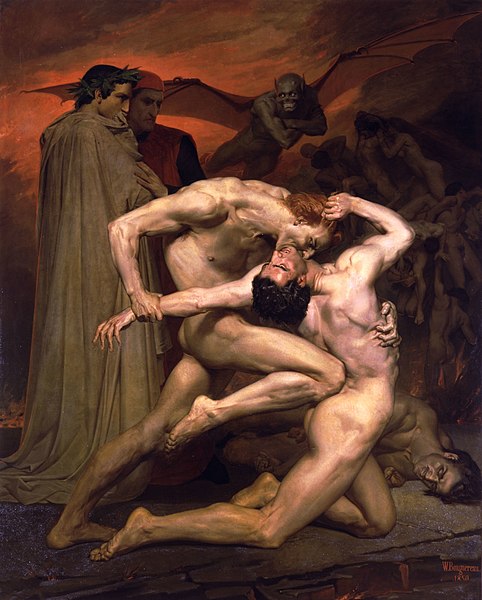
File:William-Adolphe Bouguereau (1825-1905) - Dante And Virgil In Hell (1850).jpg

Artwork courtesy of Wikimedia, public domain.  Bouguereau, I had know idea you had this in you!


*Hence the existence of bloggers.