How’s it Going, Jen?

It’s been, oh, thirty-seven years since last I blogged?

Quick recap tonight of what you’ve missed, and then as soon as I finally complete the task that is constantly getting shoved to #2 on my to-do list, presumably blogging resumes.  Since last we spoke:

I had some form of minor plague. No opinion on what it was or wasn’t.  Sore throat, headache, muscle aches, world’s lowest fever that still managed to feel like a fever, mild cough, and award-winning fatigue.

That last one I would have chalked up to old-and-out-of-shape, except two days before the plague descended, I was out running sprints and felt just fine.  Within a week of plague lifting, went out and ran sprints and felt just fine.

In between? Found myself watching Samurai Cat (loved it in a cult-classic kinda way, until I got tired of waiting for better plot developments), and then Frozen (mmnn, no, wasn’t sick enough yet), and then at the nadir I came to love Twitter, because I had enough energy to hold my phone, but not enough to hold the laptop.  At worst, sitting up even a few minutes was too tiring.

At the worst.  Large parts of the plague were not that bad.  Other than being someone who really, really loved Samurai Cat for a while. Honestly I’m half considering going back sometime and finding out if our hero ever works through his marital problems, or if he’ll just continue to stare moodily at the cat for another season.

My family attempted to run the house without me.  If this were any other year, I might have begged out of chores on the most intently plague-ridden days, and otherwise slogged through the daily grind, albeit with a little more R&R than usual.  Cover that cough but don’t let it keep you from making dinner.

But this is not any other year, so into the designated isolation ward I went.  My people muddled through as best they could, but it turns out I do a few things around this place?  So on the one hand, my convalescence was the most relaxing on record as I was forbidden to get back to work until I finally mounted a rebellion and we all googled probabilities of on-going contagiousness; on the other hand, there was plenty waiting to be remedied when I was finally set free.

Oh look! 300 pages of typos! So I spent a couple weeks digging toward the light at the end of the tunnel, none of it bad, lots of good developments on the construction front, but blogging takes a back seat.  As I was working my way through the catch-up-with-reality list, the proof of The Beast came into my hands.  It turns out that some author we know put many, many, typos into her manuscript.

Ahem.

Also: Splits infinitives.  You may have noticed.

A beloved editor of mine has a ministry of reconciliation, bringing estranged infinitives back into couplehood.  I wish her well.  I do not claim to be cured of my affliction so easily.  Will probably require several more shock-treatments.

Now what? On the to-do list:

  • Help a friend with her taxes, and maybe another friend with her taxes, and also do my own taxes, ha.
  • FINALLY write up the awesome interview I did AGES AGO that has been sitting on my desk begging for attention.  Hoping to see it at you-know-where, but if not there than the blorg or here or some other venue.
  • Got another good one in the wings, and a gazillion more I’d like to hunt down.  We have a lot of people in Catholic world doing good work on the evangelization front.
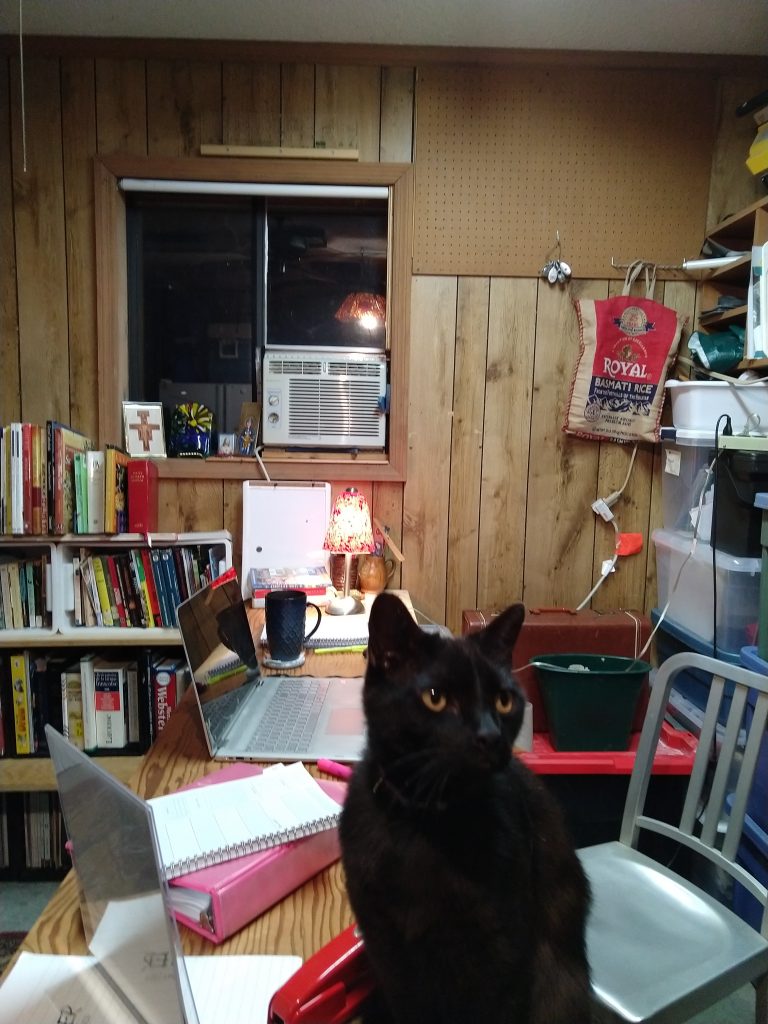
  • Continued improvements here at the castle, where life is good and check it out: I sorta have an office!  Of my own!  Still sharing it with lumber and a few remaining tools.   Plus cats.  Can’t bring myself to kick them out, even though it’s warm enough.

FYI for those who are curious, the pink binder on the desk behind Mr. Purrkins contains my marked-up copy of The Beast.

Improvised desk and bookshelves made out of crates and boards, cat in foreground. Occupies old garage space.

Sorry, no selfie, my camera has apparently given up that work.  Lent must have been too much for it.  I suppose it was for most of us.

How to Keep Your Tiger Safe from COVID-19

TigerCub
All artwork is courtesy of Wikimedia Commons. Click through on each image for descriptions and licensing information.

Now that the coronavirus pandemic has spread to tigers, you’ll want to sit down with your tiger and discuss the CDC’s recommendations for protecting itself from COVID-19.

Brahmin talking to a tiger.

It’s not always easy to talk about such a frightening and confusing topic with your tiger, so I’ve gone ahead and prepared this illustrated guide.

Hand Hygiene

Explain to your tiger that germs reside on frequently touched surfaces, such as doorknobs.

File:White Bengal Tiger at Door (11889542686).jpg

Encourage your tigers greet one another using alternatives to handshakes.

Royal Bengal tigers playing with paws in air.

Discuss the importance of frequent hand-washing,

Tiger splashing water

especially before meals.

Anthropomorphized tiger sitting down to undersized dinner (Puck)

Aim for a minimum of twenty seconds of washing with soap and water.

Bengal Tiger in Water

Social Distancing

In order to “flatten the curve” and prevent the spread of the virus, your tiger needs to learn about “social distancing.”

Young tiger playing with its mother

This includes avoiding unnecessary outings,

Two anthropomorphmized tigers going for a drive in a convertible

especially to places like crowded bars and restaurants.

Cafe Bar sign with tiger on top

While introverted tigers may be more than ready for an extended vacation from too much social time,

File:Tiger Family.jpg - Mother tiger with wide eyes

more extroverted tigers may find social isolation depressing.

File:Eugène Delacroix - Royal Tiger - Google Art Project.jpg

Your tiger may be tempted to sneak out of the house to meet with friends,

File:The Naughty Adventures of Mr. Jack by James Swinnerton cover (1904).jpg

or defy instructions to keep a minimum of one tiger-length apart.

Anthropomorphized tiger pulling back curtain on two tigers embracing

Firm, consistent reminders,

File:Kishi Ganku - Tiger - 36.100.11 - Metropolitan Museum of Art.jpg

including posters or other instructional material,

Siberian Beware of Tiger Sign

may help your tiger remember the rules.

Safe Working Conditions

Unfortunately, many tigers have jobs that involve close contact with others, who may carry the virus without realizing it.

File:Thomas Daniell - Tiger Hunting in the East Indies - Google Art Project.jpg

Tiger attacking hunters on elephant

Tiger attacking passenger elephant

Peter Paul Rubens, animal battle scene

Ask your tiger to discuss with its employer whether work-from-home is possible.

Book plate "Industria et Perseverantia" with tiger holding ruler

Certain white-collar tiger occupations naturally lend themselves to work from home.

Tiger reading long scrolling paper

Readily available software may allow your tiger to meet with colleagues via “zoom” conferences,

File:Tiger Fangs (1943) film poster.jpg

even for very large groups.

Images of wild cats in separate frames

Less-technically savvy tigers may find conferencing software overwhelming, however,

spiraling images of british colonies

and may find it simpler to conduct business via telephone.

tiger on telephone

Finally, for tiger occupations which require heading into the office, organizing the workplace to allow at least one tiger-length of space between employees can keep everyone safe.

tigers in distance approaching fort

Personal Protection Equipment

A tiger cough or sneeze can spread virus-laden droplets much farther than we realize.

File:Puck's political weather forecast for Fourteenth Street and vicinity - Dalrymple. LCCN2012648722.jpg

Unfortunately, an extensive review of the literature shows little evidence that adequate PPE is available for tigers,

Rory cartoon tiger doing laboratory experiments

and thus your tiger may have to do without, rely on donations,

Anthropomorphized tiger begging (Puck)

or sew up its own.

Boy with needle and tiger

Be Safe, Practice Tiger Distancing!

Meanwhile, readers, if you are worried about catching COVID-19 from a tiger, do like I do and keep a safe distance from tigers at all times.

PS: Feel free to share your own favorite tiger art in the blog discussion group.

***

Artwork credits, in order of appearance:

https://commons.wikimedia.org/wiki/File:TigerCub.jpg

https://commons.wikimedia.org/wiki/File:Tiger-Brahmin-Jackal.gif

https://commons.wikimedia.org/wiki/File:White_Bengal_Tiger_at_Door_(11889542686).jpg

https://commons.wikimedia.org/wiki/File:Royal_bengal_tiger_play.jpg

https://commons.wikimedia.org/wiki/File:Don_go_away.jpg

https://commons.wikimedia.org/wiki/File:Big_dish_but_mightly_little_turkey_LCCN2012648582.jpg

https://commons.wikimedia.org/wiki/File:Bengal_Tiger_in_Water_(13290323163).jpg

https://commons.wikimedia.org/wiki/File:Young_tiger_playing_with_its_mother.jpg

https://commons.wikimedia.org/wiki/File:Conti_echo_23_winter.jpg

https://commons.wikimedia.org/wiki/File:Bar_Trafalgar_-_Santiago_de_Compostela.jpg

https://commons.wikimedia.org/wiki/File:Tiger_Family.jpg

https://commons.wikimedia.org/wiki/File:Eug%C3%A8ne_Delacroix_-_Royal_Tiger_-_Google_Art_Project.jpg

https://commons.wikimedia.org/wiki/File:The_Naughty_Adventures_of_Mr._Jack_by_James_Swinnerton_cover_(1904).jpg

https://commons.wikimedia.org/wiki/File:Sc%C3%A8nes_de_la_vie_priv%C3%A9e_et_publique_des_animaux,_tome_1_0480.jpg

https://commons.wikimedia.org/wiki/File:Kishi_Ganku_-_Tiger_-_36.100.11_-_Metropolitan_Museum_of_Art.jpg

https://commons.wikimedia.org/wiki/File:Siberian_Tiger_Sign_cropped.jpg

https://commons.wikimedia.org/wiki/File:Thomas_Daniell_-_Tiger_Hunting_in_the_East_Indies_-_Google_Art_Project.jpg

https://commons.wikimedia.org/wiki/File:Briton_Rivi%C3%A8re_Tigerjagd.jpg

https://commons.wikimedia.org/wiki/File:W._Jardine,_Natural_History_of_Pachydermes…_Wellcome_L0030793.jpg

https://commons.wikimedia.org/wiki/File:Peter_Paul_Rubens_110.jpg

https://commons.wikimedia.org/wiki/File:Hume_bookplate.jpg

https://commons.wikimedia.org/wiki/File:Colorado_College_Nugget_(yearbook)_(1904)_(14777209654).jpg

https://commons.wikimedia.org/wiki/File:Tiger_Fangs_(1943)_film_poster.jpg

https://commons.wikimedia.org/wiki/File:Das_thierleben_in_Sch%C3%B6nbrunn_(1904)_(20219627673).jpg

https://commons.wikimedia.org/wiki/File:Bodleian_Libraries,_Tour_through_the_British_colonies_and_foreign_possessions.jpg

https://commons.wikimedia.org/wiki/File:Review_of_reviews_and_world%27s_work_(1890)_(14784324615).jpg

https://commons.wikimedia.org/wiki/File:Birmania,_caccia_alla_tigre,_1900_ca..JPG

https://commons.wikimedia.org/wiki/File:Puck%27s_political_weather_forecast_for_Fourteenth_Street_and_vicinity_-_Dalrymple._LCCN2012648722.jpg

https://commons.wikimedia.org/wiki/File:Rory_experiment.png

https://commons.wikimedia.org/wiki/File:In_dire_distress_-_F._Opper._LCCN2012648559.jpg

https://commons.wikimedia.org/wiki/File:John_d_batten_1892_10.jpg

On my bookshelf, Holy Week 2020 and beyond

This is my long overdue post on what I’ve been reading and what I’ve got in the queue, some of it Lenten some of it not (except, of course, that everything is Lenten).

For my top picks of family-friendly Holy Week videos, look here.

Simcha’s Lenten Family Film Festival is here, and Julie Davis has a starter pack of Lenten viewing here, but her whole blog is a treasure trove of reading and viewing suggestions.

***

My Good Friday go-to is Thomas à Kempis’s On the Passion of Christ.  I read a little bit more of it every year.

On the Passion of Christ by Thomas a Kempis

So no, I wasn’t kidding when I recommend partial-book reading as a Lenten strategy.  It’s a thing. Sometimes a very spiritually fruitful thing.  This is definitely a book for which a single meditation — even just a few paragraphs — can go a long, long ways.

Not recommended for those prone to scrupulosity.  Ideal for those prone to laxity.  Great example of using one’s imagination to immerse oneself in Scripture as a method of prayer, btw.

And hence: Not for the scrupulous. Just no.  NO!

If you are prone to scruples, for goodness sakes do like my kid did today, unbidden, and grab a few of Pauline Media’s Encounter the Saints books.  Good for kids, ideal for busy adults who need a quick inspiring read that will challenge your faith.  Can’t have too many of these.

Just finished: All Blood Runs Red: The Legendary Life of Eugene Ballard — Boxer, Pilot, Soldier, Spy by Phil Keith and Tom Clavin.  I give it . . . I dunno.  A lot of stars.  Also, I demand a mini-series.  Talk about non-stop fodder for period drama . . . the adventures just. never. quit.

Of Catholic interest: Somewhere along the way, Eugene Ballard managed to become a Catholic, often a lousy but also compulsively-heroic Catholic, and he died reconciled to the Church.  The biography doesn’t treat his faith very extensively, which is probably just as well; when THEY MAKE THE MINI-SERIES, which I demand, they’d better not screw up the Catholic part.

All Blood Runs Red: The Legendary Life of Eugene Bullard-Boxer, Pilot, Soldier, Spy

Did I mention I demand a mini-series?  This is a great story.

Currently reading: 

I apologize if you thought I was reading Lentier-stuff.  Well, these are Lenty each in their way.  Everything is Lenty.

Okay but I have another one open that is properly Lent-themed:

Just Sayeth the Lord: A Fresh Take on the Prophets by Julie Davis.

Thus Sayeth the Lord by Julie Davis

I’m a few chapters in, and so far so good.  Down-to-earth recaps, explanations, and meditations on the stories of various prophets.  Based on the what I’ve read, I’d definitely consider this one as a choice for a parish book club or Bible study, ages teen and up.

Readable, does not assume a particular level of background knowledge, does provide spiritual insights useful to those who are already well-studied.

It is of course no secret I’m a Julie Davis fan.  Her other two books are quite different and heartily recommended:

(Head’s up: At this writing I am not active on Goodreads, so please don’t try to message me there and then wonder why I’m ignoring you.)

Next Up:

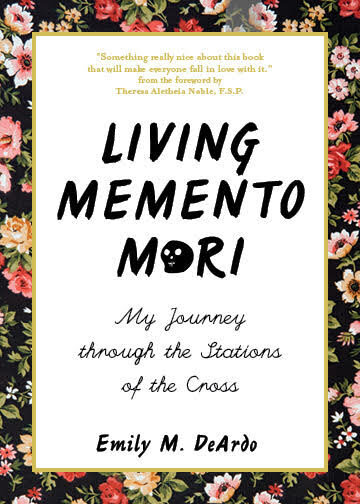
Living Memento Mori: My Journey Through the Stations of the Cross by Emily DeArdo.  I’ve actually kinda sorta already read this book? But not exactly.

Living Momento Mori by Emily DeArdo

Emily is one of my favorite internet writer-friends, and she let me take a look at the original manuscript for this book back when we were trying to figure out who would be the ideal publisher.

Ave Maria was the winner, and their request was that she organize her memoir around the Stations of the Cross — if you didn’t know this already, one of the things publishers do with book proposals and manuscript drafts is come back to the author with requests for how to modify the book to better serve their readers.  It’s up to the author, of course, to decide which suggested changes fit with the goals of the book and when it’s time to stand firm (even at the cost of walking, if it comes to it); Emily obviously decided that the stations theme worked with her story, and I trust her instincts on that one.

I haven’t read the Stations of the Cross version, and no, I don’t feel, for a moment, that somehow that framework will become obsolete come Easter.  I have a sneaking suspicion, sorry to say, that Momento Mori is going to remain a pertinent theme for many months to come.

In the future I am going to recommend that Emily write something like My Memoir of Everything Being Awesome and Life is a Cakewalk, and maybe world events will take a hint?

And finally, you knew it was coming, I’m eager to finally be able to crack open The Contagious Catholic: The Art of Practical Evangelization by Marcel LeJeune.

The Contagious Catholic by Marcel LeJeune

Call it Providence or coincidence, but I assure you Catholic publishers don’t get six months advance notice on upcoming world events and tailor their book titles accordingly.

In what is definitely Providence, here’s the story of how we ended up writing overlapping books coming out within just months of each other: I had a brief online conversation with Marcel about the same time I was pitching my book proposal to OSV.  He mentioned in conversation that he had a book (he didn’t elaborate on the specific topic) in mind but had no idea when he’d get around to writing it or finding a publisher for it.

So I figure: Okay, he’s the guy to write about a book about this, but he’s not writing the book.

Makes sense. He’s a really busy guy running a major ministry teaching people how to evangelize, and his priority is to do the thing.  So someone needs to write the book on how to do the thing.  We get lots and lots of people who are excited about evangelization but are seriously wondering, “Okay, how do we do this?” because they’ve never been in a parish where evangelization and discipleship happen for serious.

I’m a writer.  I’m not running a major ministry that is sucking up all my time.  He can do the thing and I can write about the thing.  I guess I’ll do that.

There is no way — let me repeat: NO WAY — I would have even proposed my book if I’d known Marcel was writing his.  So it’s a good thing I did not know that he was going to end up finding time to get his manuscript together, because he has read my book now, and here’s his verdict in his email feedback to me:

You hit a lot of areas that I did not, and it seems the most  important ones were covered in our own ways by both of us.

That sounds about right.  You can check out the Catholic Missionary Disciples blog here to get a feel for Marcel’s writing style and the topics that interest him, how he and I overlap each other, and how is depth of experience is going to bring a different perspective than mine.

Anyway, now that I’m finally done with edits (other than a final look after the copy-editor has finished cleaning up the no-good, horrible, very-bad typos I’ve already identified from my “final” draft after pushing the send button), I’m free to read Marcel’s book with no risk of accidental plagiarizing, and so that’s what I am itching to do.*

Girl with preztels covering her eyes, in front of bookshelf.

For today’s photo penance, let’s do a fresh young face from the camera roll: A child of mine in attendance at a Family Honor parent workshop SuperHusband and I were giving last year.  This is what happens when you let her borrow your laptop.

*If you’re wondering: I’m pretty strict with myself about not reading other people’s blog posts or books on a topic I’m actively writing on, except if I’m explicitly researching a response to that literature. So I spent many months not clicking through on Marcel’s blog links because I didn’t want his voice getting confused with my own while I was actively writing.

Could I recommend you read, memorize, and internalize every single thing he writes on his blog?  Yes.  I recommend that.

And then go do the thing. DO. THE. THING.  Thank you.


How to Pick Comfortable Mask Fabric

TLDR: Choose any single 100% natural fabric.

Details follow.

***

The CDC has finally come around on the usage of cloth masks by the general public.  Amen.

Masks aren’t magic.  They are one piece in a whole collection of safety tactics that, when combined, make things less-bad.  It’s just like how your car has many safety features that work together with your safe driving skills, or your table saw comes with safety features that are in addition to, not instead of, your decision to always know where all your fingers are.

But covering one’s mouth and nose does help.  So do that.  This is the post where I explain to you the trick of how to cover your face with a fabric that will be relatively more comfortable.

My credentials: I spend a lot of time playing outside in a hot, humid climate.

***

Now you might live someplace cool and dry.  But your mouth and nose are little heat-n-humidity factories. The whole point of wearing a cloth mask is to keep your hot, moist exhalations to yourself.  In other words, by masking up you are getting the Southern Summer Experience plastered to your face.

Please. Allow me to guide you on how to take the edge off, because the last thing we want is your desperate panting miserable self to rip off your mask as you let out a primal scream in the Walmart checkout line.

To spare us all, here’s the fabric you need:

  • Any single
  • 100%
  • natural fiber.

Working backwards:

NATURAL means: Cotton, wool, silk, or linen.

You’ll need to get out your reading glasses to read the fine print.  Cotton is the most widely used, but any of these can work.  You may find tightly-woven silk in the upholstery department.  You may find tightly-woven linen in the form of a table cloth or napkin.  We’ll talk about wool below.

Yes, I know there are hi-tech wicking fabrics.  If you have a garment you find very comfortable in hot sweaty conditions, perhaps an old pair of hi-performance long underwear from your trekking expedition or something, have at it.

But if you must buy new fabric, buy natural because it’s widely available, cheap, and proven.  “Wicking” or “breathable” synthetics sometimes are what they promise (more likely so if coming from a reputable purveyor of technical mountaineering gear, just sayin’), and sometimes they are hype.  You’ll have to test for yourself, and not everyone has the money to gamble on tests.

Be warned: “Natural” fibers do not include, for this purpose, bamboo or other modern-day recycling projects.  Those kinda-natural inventions don’t function the way traditional natural fibers do.  Cotton, wool, linen, or silk. Those are the ones you want.

Review Q&A: What does natural mean?  It means cotton, wool, linen or silk.

100% means: ONLY the single natural fabric you have chosen, no other material of any other kind.

Your cotton skinny jeans with “just a touch” of spandex are NOT 100%.  Your cotton socks are highly unlikely to be only cotton, they probably have some kind of stretchy thing that makes them hold their shape.

Many, many, many natural fabrics used in clothing or sold at fabric stores contain either a poly-blend (looking at you, t-shirts) or a small amount of spandex or lycra to improve fit.

Read the label.  Your stash of old t-shirts probably contains both 100% cotton and cotton-poly blend t-shirts.  Read every label.  Your favorite bandanna might be 100% cotton or might be cotton-poly. Read the label.  Your worn-out wool sweater (blazer, skirt, etc.) you could never quite bring yourself to throw away (more below) might be 100% wool or it might be a wool-blend.  Read. the. label.

Review Q&A: What does 100% mean?  It means that when you read the label, it says 100% of either cotton, silk, linen, or wool, and NOTHING else.

SINGLE means: I don’t trust you with that 100% concept.

Ha!  It means this: ONLY cotton, or ONLY wool, or ONLY linen, or ONLY silk.

Linen-cotton blends, for example, are popular for summer shirts and for table linens.  This is a trick! Don’t fall for it!  Yes, the two fibers are both 100% natural. But when you blend them, you lose the comfort of a single-fiber natural fabric.

Trust me on this.  I know.

Other common combos, especially in scarves and luxury fabrics, are wool-and-silk or linen-and-silk.

These will not help you.  Do not use these in your homemade or improvised face mask or you will become a sweaty mess.  Go for a SINGLE natural fiber in your 100% natural fabric.

Review Q&A: What does single mean?  It means that your fabric is composed of only one type of natural fiber.

Readily Available Sources of Single-Fiber 100% Natural Fabric

There’s a good chance you already have something sitting around your house that can be converted into an improvised face covering.  Some sources to look for:

  • T-shirts
  • Pillowcases or sheets
  • Cloth napkins
  • Table cloths
  • Mom-jeans, Dad-jeans, and cargo shorts
  • Flannel shirts
  • Dress shirts
  • Curtains
  • Tote bags
  • Bandannas
  • Jackets

And yes, sweaters.  (See below!)  Naturally you aren’t going to cut up a perfectly good garment unless you have no other choice, but you might have something that is stained, pilled, worn through at the knees or elbows, or otherwise ready for re-purposing.

In the average household, your best bets for re-purposing are going to be:

  • That ratty old thing your husband won’t quit wearing because he loves it, but seriously, it’s time.
  • That awful dress your six-year-old loves, and insists she still wear, but hello it was her favorite when she was TWO and now not only is it permanently ketchup-marked, it is also no longer working even as a shirt.
  • The fabulous piece you got on clearance because you love the fabric, but the cut of the garment is horribly unflattering and no amount of belting or cardigans can fix that, and you need to move on.

Find these things, read the labels, and if they are a 100% natural single-fiber fabric, they are perfect for your home-made or improvised face covering.

Finally, let’s talk about wool.

Two things you need to know:

  • Usually knitted items are a very loose fabric that won’t help much for keeping your cough to yourself.
  • Wool shrinks in the wash.

If you know what you’re doing, you can use this to your advantage.  “Felting” is the process of washing and drying a wool fabric until it shrinks up into a tight fabric.  When you do this to your gorgeous handmade Christmas sweater, by accident, instead of hand-washing and laying flat to dry, you end up with a doll-sized sweater.  Oops.

But fast forward to today, when you are now eyeing up that wool garment you own that is either no longer presentable, or else it never really was suitable for any human to wear anyway, no matter how much the giver meant well when she gave it to you.

You can use this item for mask-making (having confirmed by reading the label that it is indeed 100% natural single-fiber-type wool), but first you need to felt it.  Do that by running it through the hot wash and dryer a bunch of times until it quits shrinking.

That’s it.  Not complicated.  You need to do this not only because you want to tighten-up that weave or knit, but also because it’s no good to have a mask you can’t wash and dry — you’ll just end up making doll masks.  Ha.

Thank you for coming to my TED Talk.

Okay that’s it for today’s lecture.  Remember, if you don’t want to pass out from heatstroke or infect the world in a sweat-crazed rage as you tear your drenched mask-of-misery from your overheated face, make your homemade mask out of fabric that’s:

  • 100%
  • natural
  • single-fiber

That’s 100% of or cotton or linen or silk or wool.

You’re welcome.

File:GreenMask1.jpg

Artwork: The Green Mask comic book cover, circa 1940, via Wikimedia, public domain.  This is not the right pattern for slowing the spread of respiratory illness.  Pretty sure your forehead is not a major vector of contagion.

On the other hand, let’s say it now right now: If you would also wear whatever glasses you have on hand when you must venture out, that, too, would add yet another layer of protection, however minimal.